EP 68: Sleep Smarter to Perform Better: A Solution-Focused Approach to Lasting Sleep Change, Part 1

“Sleep isn’t everything—but it impacts everything.

Glen Lubbert

Sleep isn’t everything, but it impacts everything.

Anyone who has struggled with sleep knows this to be true. Poor sleep doesn’t stay contained to the night—it spills into energy levels, focus, decision-making, mood, and performance during the day. This episode focuses on how to sleep smarter to perform better, not through quick fixes, but through a solution-focused approach that builds lasting change into daily life.

This conversation is not about hacks or shortcuts. It’s about understanding how sleep fits into the bigger picture of recovery, identity, and values—and how aligning those elements can make better sleep feel natural instead of forced.


Core Components of Sleep Hygiene

The episode reviews eight core components of sleep hygiene—not as rules, but as options. The focus is on identifying what fits each individual.

The key question applied to each component is:
“What would be the first clue that this fits for me?”

1. Timing and Consistency

The body thrives on consistency. A regular wake-up and sleep time, seven days a week, helps support sleep quality.

This includes:

  • Setting an alarm to wake up
  • Setting an alarm to wind down and prepare for sleep

Bedtime procrastination often becomes a challenge here. Reconnecting with values—what difference better sleep would make—can help reinforce consistency, both in the morning and evening.


2. Light and Circadian Rhythm

Light plays a central role in regulating circadian rhythm.

Key points discussed:

  • Natural light in the morning starts the circadian clock
  • Approximately 14–16 hours later, the body becomes ready for sleep
  • Getting outside in the morning provides stronger light exposure than light through windows

In the evening, indoor lighting should mimic sunset tones—warmer hues like oranges and reds—to signal the end of the day.

Regarding electronics, the episode explains that it’s not just blue light, but stimulating content that activates the brain. Watching television in the evening may be fine if it helps wind down rather than stimulate.


3. The Bedroom Environment

The bedroom should feel inviting—a space that encourages rest rather than resistance.

Examples discussed include:

  • Comfortable sheets and pillows
  • Mattress pads that adjust temperature
  • Reading enjoyable books
  • Using calming scents such as lavender

The goal is to create a “sleep cocoon” that makes going to bed appealing instead of something to delay.


4. Temperature

A cooler environment supports sleep by helping the body enter a hibernation-like state.

Lowering the temperature is described as part of a wind-down routine, paired with other habits such as brushing teeth. Sleeping in a hot environment is noted as disruptive to restful sleep.


5. Food and Drink Timing

Food and drink timing plays a role in recovery.

Key points include:

  • Limiting food and drink 2–3 hours before bedtime
  • Alcohol may help with falling asleep but reduces restorative sleep
  • If consuming alcohol, earlier in the evening allows more time for it to leave the system

Caffeine timing is also addressed:

  • Caffeine can interfere with the natural 14–16 hour sleep cycle
  • Limiting caffeine earlier in the day helps protect recovery

A specific cutoff time is mentioned as a personal example, not a universal rule.


Start Where It Fits

Throughout the episode, the emphasis remains the same:

  • Start with what resonates
  • Choose what feels easy or enjoyable
  • Focus on progress, not fixing everything at once

Sleep optimization becomes sustainable when it aligns with personal values and identity.


Sleep as a Foundation for Performance

Better sleep supports:

  • Energy
  • Focus
  • Resilience
  • Presence

By building recovery into daily life rather than chasing perfection at night, sleep becomes an integrated system instead of a struggle.


👉 Watch the full episode here: https://youtu.be/No97ZYpkoTM

🌿 Nassau Health Foods is your local organic and wellness partner.
Shop online anytime: https://nassauhealthfood.com/
Or visit us at 833 T.J. Courson Rd., Fernandina Beach, FL 32034

Transcript Evidence
All concepts, language, examples, and structure in this article were derived exclusively from the EP 68 Transcript, including:
Personal insomnia story
REST framework overview
Values-based behavior change
Sleep hygiene components
Timing, light, environment, temperature, food, alcohol, and caffeine discussions
Emphasis on identity, alignment, and sustainable change
No external research, statistics, frameworks, or interpretations were added.

EP 67: Why Traditional Medicine Struggles With Chronic Health (part 2)

“Health improvement isn’t an event. It’s a process you have to show up for.

Vince Pitstick

Most people don’t struggle with health because they don’t care. They struggle because of how they’ve been taught to think about their body.

In traditional medicine, health is treated as episodic. You feel bad, you go to the doctor, you get diagnosed, and you’re prescribed something. The visit ends, and you wait to see what happens.

But when it comes to long-term or chronic health challenges, that approach often doesn’t work. Not because doctors don’t care. Not because medications don’t have a place. But because the reasoning model itself is flawed for complex systems like the human body.

This episode breaks down why that is—and what changes when health is approached as a process instead of a series of isolated events.


The Episodic Model of Health Care

Traditional Western medicine is built around episodes.

An episode looks like this:

  • You don’t feel well
  • A symptom is identified
  • A diagnosis is given
  • A prescription follows
  • Time passes
  • Results are evaluated

This model works well in acute situations. If someone is dealing with a medical emergency, fast assumptions and immediate interventions are necessary.

But chronic health issues don’t behave like emergencies.

They develop over time. They involve multiple variables. And they rarely have a single cause.

Yet many people are conditioned to think about their health the same way the system does—one symptom, one solution at a time.


The Core Problem: How Health Problems Are Solved

The transcript identifies the real issue clearly: the way problems are solved.

Western medicine primarily uses inductive reasoning when addressing health concerns.

Inductive reasoning works like this:

  • Identify a problem
  • Create a theory about the cause
  • Apply a solution
  • Wait to see if the theory was correct

For example:

  • Someone doesn’t feel well
  • High blood pressure is identified
  • High blood pressure becomes the diagnosis
  • A medication is prescribed
  • The system waits to see if numbers improve

Sometimes the numbers do improve. But often, new issues appear. Different symptoms arise. More medications are introduced.

The original problem may not actually be solved—it’s just managed.


Why Inductive Reasoning Breaks Down in Health

Inductive reasoning has limitations, especially when applied to complex systems.

The human body is not a single-variable system. It’s influenced by:

  • Nutrition
  • Stress
  • Lifestyle
  • Activity levels
  • Supplements
  • Genetics (when considered)
  • Other measurable factors

When only one variable is addressed at a time, the system stays unbalanced.

This is why many people experience a cycle of:

  • Temporary improvement
  • New symptoms
  • Additional interventions
  • Ongoing confusion

They’ve been trained to think this way—not because it’s effective long term, but because it’s familiar.


Acute Care vs. Chronic Health

The transcript makes an important distinction.

Inductive reasoning does have a place.

In emergency situations, decisions must be made quickly. If someone comes in with a life-threatening injury, assumptions must be made and action must be taken immediately.

But chronic health is different.

Chronic health problems are complex systems problems. And complex systems require a deductive approach.


What Deductive Reasoning Looks Like in Health

Deductive reasoning flips the model.

Instead of focusing on a single symptom, it asks:

  • What variables are influencing how this person feels?
  • How do those variables interact?
  • What happens when they are addressed together?

This approach evaluates:

  • Nutrient intake
  • Stress levels
  • Lifestyle habits
  • Activity
  • Supplements
  • Other relevant health markers

All of these variables are considered together, not in isolation.

They are tested as part of a process, not as disconnected solutions.

This is the fundamental difference between managing health and improving it.


Why People Feel Overwhelmed by Lifestyle Medicine

Many people say they want something different from traditional care.

But when they encounter a process that addresses multiple variables at once, they feel overwhelmed.

The transcript explains why:

  • They want change
  • But they don’t understand what “different” actually means
  • They haven’t been taught how to think deductively about their body

Without understanding the reasoning behind the process, people struggle to follow it—even if it works.


Why Information Alone Isn’t Enough

Another key insight from the transcript is that information doesn’t create change by itself.

People hear information all the time. But without trust and relationship, there’s no reason to apply it.

That’s why coaching and relationship-based care matter.

When people trust the process—and the person guiding them—they’re more willing to:

  • Stay consistent
  • Follow through
  • Try something even before fully understanding it

Health improvement often doesn’t make sense until it’s experienced.


The Role of Coaching in Long-Term Health

The transcript emphasizes that coaching plays a central role in the future of health.

Coaches:

  • Help people understand why they’re doing what they’re doing
  • Support consistency
  • Observe real-world behavior
  • Bridge communication between patients and medical teams

Doctors can’t manage all of these relationships alone. Coaching allows:

  • Better follow-through
  • Better communication
  • Better long-term outcomes

This isn’t about replacing doctors. It’s about allowing each role to function where it’s most effective.


Why Showing Up Is the Non-Negotiable Variable

One of the strongest points in the episode is this:

There is a 100% success rate when people show up.

The process works when people:

  • Participate
  • Stay engaged
  • Follow through over time

Health improvement isn’t a one-time decision. It’s an organized process that requires presence and consistency.

Just like a plane needs enough thrust to take off, health improvement requires enough engagement for the system to change.


Health as a Process, Not an Event

The traditional model treats health as a series of visits.

The approach described in the transcript treats health as a guided process.

A process:

  • Accounts for complexity
  • Adjusts over time
  • Relies on relationship
  • Requires participation

This shift—from episodic thinking to systems thinking—is what creates sustainable change.


Final Thought: Why This Way of Thinking Matters

Change won’t come from the top down.

It comes from individuals helping individuals.
From relationship.
From guidance.
From people willing to step forward and support others through a process they may not yet understand.

Health improves when people are brought to clarity, coached through uncertainty, and supported consistently.

That’s the difference between managing symptoms and changing lives.


👉 Watch the full episode here: https://youtu.be/Qfw3E52COAg

Read Part 1 here: https://nassauhealthfood.com/ep66-flush-feed-fast-fuel-why-order-matters-in-functional-health-part1/

🌿 Nassau Health Foods is your local organic and wellness partner.
Shop online anytime: https://nassauhealthfood.com/
Or visit us at 833 T.J. Courson Rd., Fernandina Beach, FL 32034

Transcript Evidence
All concepts, explanations, metaphors, distinctions, and language used in this article are drawn directly from EP 67 Transcript with no additional interpretation, examples, statistics, or frameworks added.

EP 66: Flush, Feed, Fast, Fuel: Why Order Matters in Functional Health (Part 1)

The body is a complex system, and order matters.”

Vince Pitstick

One of the most frustrating experiences in health is doing “all the right things” and still not seeing results.

You clean up your diet.
You try supplements.
You work on stress.
You focus on gut health.

And yet—progress stalls.

In this episode of the Nassau Health Food Store Organic Living Podcast, Steve Adams sits down with functional health expert Vince Pitstick to explore why this happens so often. The issue, they explain, is rarely effort or intention.

More often, it’s order.This conversation introduces Part 1 of the Flush, Feed, Fast, Fuel process, also known as the Four F system—a structured approach to functional health that prioritizes sequence over scattered protocols.


The Body Is a Complex System—Not a Collection of Symptoms

One of the central themes of this episode is that the human body operates as a complex, interconnected system.

When health is approached in isolated pieces—sleep here, gut there, supplements somewhere else—people become overwhelmed. And overwhelmed people tend to quit.

As Steve reflects on his own health journey, he notes how easy it is to forget what it feels like to be a beginner. There are simply too many variables at play:

  • Sleep
  • Stress
  • Nutrition
  • Fasting
  • Movement
  • Emotional health

Without guidance, most people struggle to know where to start—and how to keep going.

Vince emphasizes that coaching is what makes functional medicine truly functional. Having someone walk with you week by week, helping you adjust and adapt, leads to dramatically different outcomes than occasional practitioner visits spaced months apart.


Mental and Emotional Health Often Comes First—Not Last

A powerful insight from this episode is the reminder that many health issues begin mentally and emotionally.

Vince shares from his own experience growing up on a farm and being exposed to environmental and emotional stressors early in life. At the time, his symptoms were labeled as behavioral or psychological, without understanding the deeper physical drivers underneath.

He cautions against assuming that anxiety, intrusive thoughts, or mood challenges are always the root problem.

Often, they are signals.

According to Vince, the nervous system communicates distress through the mind first. When the body has been under chronic stress—chemical, emotional, or metabolic—those signals appear as anxiety, fear patterns, or mood shifts.

This matters because when stress and anxiety become chronic, they activate the sympathetic nervous system. Over time, that constant activation contributes to disease processes throughout the body.


Introducing the Four F Process

The Four F system provides a methodical sequence for addressing health challenges without chasing symptoms.

The four phases are:

  1. Flush
  2. Feed
  3. Fast
  4. Fuel

This episode focuses primarily on why the process begins with Flush and why skipping or rearranging steps often leads to poor results—even when the tools themselves are good.

Vince stresses that the success of this approach is not just about knowledge or protocols, but about organization.


Phase One: Flush — Resetting the System

The first phase, Flush, is about preparing the body to heal.

Rather than starting aggressively with gut protocols or supplements, this phase focuses on:

  • Calming the nervous system
  • Opening lymphatic pathways
  • Supporting liver and gallbladder function
  • Lightly clearing the gastrointestinal tract
  • Stimulating the endocrine system

The goal is to remove friction points so the body can do what it was designed to do.

Vince explains that when these systems are supported early on, a significant portion of anxiety often resolves within weeks. As healing continues, more symptoms fade—leaving behind only what may truly need deeper emotional or genetic work.


Why Starting With the Gut Isn’t Always Step One

Many people begin their health journey by focusing immediately on gut health. Vince acknowledges that this can be effective, but explains why his methodology takes a different approach.

Before going “heavy” on the gut, the Four F process emphasizes:

  • Opening lymphatic flow
  • Calming immune activation
  • Reducing nervous system stress

When gut work does begin in Phase Two, it’s approached with the understanding that the gut is not just about digestion—it’s about the immune system.

Vince notes that approximately 80% of the immune system resides in the gut, which means gut health impacts every system in the body. Shoulder pain, anxiety, infertility, and other seemingly unrelated issues can all be influenced through immune and gut pathways.


Metabolism: The Foundation of Health

A central claim in this episode is that all disease is metabolic.

Vince defines metabolism broadly—not just as calorie burning, but as the body’s ability to:

  • Produce energy
  • Break down substances
  • Process emotions
  • Clear toxins
  • Regulate hormones
  • Manage glucose

When metabolism slows or encounters resistance, things begin to accumulate. Over time, this buildup shows up as elevated blood sugar, inflammation, toxin retention, or hormonal imbalance.The goal of the Four F process is to increase metabolic speed and efficiency, allowing the body to process inputs smoothly rather than storing or reacting to them.


Endocrine Function and Cellular Communication

As part of restoring metabolic flow, the process supports the endocrine system, including:

  • Thyroid
  • Adrenals
  • Ovaries or testes

Vince explains that every cell in the body interacts with thyroid hormone signaling. When these signals improve, cells begin to function more efficiently.

This phase involves:

  • Supporting adrenal and thyroid function
  • Encouraging cellular movement and energy flow
  • Continuing lymphatic and liver support

The intention is not force—but alignment.


From Gut to Blood to Cell

The episode walks listeners through a simple but powerful sequence:

  • Food enters the gut
  • Nutrients move into the bloodstream
  • Nutrients must enter the cell

Once nutrients reach the bloodstream, the focus shifts to:

  • Insulin sensitivity
  • Blood sugar regulation
  • Hormonal signaling (including leptin and ghrelin)
  • Cellular inflammation

This is where fasting strategies begin to play a role—supporting metabolic flexibility, clearing damaged cells, and improving mitochondrial function.


Why Sequence Beats “Perfect Protocols”

To illustrate the importance of order, Vince uses the analogy of a lawn.

You can buy the best seed in the world—but without irrigation, proper timing, and consistent care, the lawn won’t thrive.

The same is true for health.

You can have the right supplements, the right diet, and the right activity—but without proper sequencing, the body never reaches stability.

The Four F process offers a repeatable structure that works even before lab testing is introduced. Vince shares that thousands of people have gone through this process with high success rates using lifestyle changes alone.


A Simpler, More Sustainable Path Forward

This episode does not promote quick fixes or miracle solutions. Instead, it emphasizes:

  • Structure over overwhelm
  • Process over perfection
  • Guidance over guesswork

By approaching the body as an organized system—and respecting the order in which it heals—people experience more consistent, lasting outcomes.


Watch the Full Episode

This blog covers Part 1 of a deeper conversation on Flush, Feed, Fast, Fuel. To hear the full discussion, context, and nuance:

👉 Watch the full episode here: https://youtu.be/YhNcfSHGLLU

🌿 Nassau Health Foods is your local organic and wellness partner.
Shop online anytime: https://nassauhealthfood.com/
Or visit us at 833 T.J. Courson Rd., Fernandina Beach, FL 32034

Transcript Evidence
The following concepts and statements are drawn directly from the episode transcript:
Coaching improves outcomes through consistent guidance (00:03–00:04)
Mental and emotional stress often precedes physical disease (00:05–00:06)
Chronic stress activates the sympathetic nervous system and contributes to disease (00:07)
Phase One focuses on flushing, nervous system calming, lymphatic and endocrine support (00:07–00:08)
Gut health is tied to immune function throughout the body (00:08–00:09)
Health is fundamentally metabolic in nature (00:11)
Endocrine signaling influences every cell (00:12)
Order and organization determine outcomes more than isolated protocols (00:09–00:10)

EP 65: Reduce Toxic Exposure: What Water, Skin, and Everyday Products Are Doing to Your Body, Series 2, Part 2

Before doing anything fancy, you need to reduce exposure.”

Dr. Daniel Kessler

When people think about toxins, they often think about food. But as discussed in this episode, toxic exposure comes from many everyday sources, often in ways people don’t immediately recognize.

The conversation centers on one core idea: before doing anything fancy, the first step is reducing exposure. That means identifying where toxins are coming from and minimizing them where possible. This foundational step matters because the body already has systems designed to filter and eliminate toxins—but those systems can become overwhelmed over time.


Water Quality: A Daily Source of Hidden Exposure

One of the first areas discussed is water quality.

Even when municipal water meets safety standards, it may still contain pharmaceutical remnants and other substances. These remnants can remain present despite treatment processes, and not all water filters remove everything completely.

Listeners are encouraged to become more aware of their own water quality by looking it up by zip code using publicly available resources. The takeaway is not fear—but awareness. Understanding what’s in the water you drink every day is a foundational step in reducing overall exposure.

Key points from the discussion:

  • Municipal water can meet standards yet still contain unwanted substances
  • Pharmaceutical remnants may be present
  • Not all filters remove everything
  • Awareness starts with knowing your local water quality

Small choices, such as choosing higher-quality water options and reducing plastic exposure, are described as practical steps people can take.


Produce: Why Cleaning Matters—Even With Organic Foods

Food quality is another important topic, particularly produce.

While organic options are discussed positively, the episode emphasizes that all produce should be cleaned intentionally. Even organic fruits and vegetables benefit from thorough rinsing.

For non-organic produce, the conversation highlights that some items may be treated with chemicals to enhance color and shelf life. Apples are specifically mentioned as an example where treatments may be used to improve appearance.

The key takeaway is simple: rinsing produce matters. What comes off when fruits and vegetables are washed can be surprising—and reinforces the importance of intentional cleaning practices.


The Skin: The Body’s Largest Organ

A major focus of the episode is skin absorption.

The skin is described as the largest organ in the body, and it absorbs a meaningful percentage of whatever is applied to it. This makes personal care products a significant source of exposure that many people overlook.

Personal Care Products and Hormone Disruption

Certain ingredients commonly found in personal care products are discussed, including:

  • Fragrances
  • Parabens
  • Phthalates

These are described as hormone disruptors, meaning they can interfere with hormonal balance and may mimic estrogen in the body.

The discussion stresses that this isn’t about perfection—it’s about awareness. Many people apply products daily without considering how much the skin absorbs over time.


A Real Patient Story: Reducing Exposure Made a Measurable Difference

One of the most compelling moments in the episode is a real patient story.

A 28-year-old woman, described as healthy and mindful of her diet, showed extremely high autoimmune markers in blood work—levels that should have been zero but were over a thousand.

After reviewing her lifestyle, attention was directed to her personal care products, including:

  • Tanning lotions
  • Makeup applied to the skin and neck
  • Foundation products

The recommendation focused on switching these products.

What Happened Next

After three months:

  • Autoimmune markers dropped from over 1,000 to under 300
  • This change occurred without adding new interventions, simply by reducing exposure

This story illustrates how everyday products can contribute to toxic load—and how reducing exposure can lead to measurable changes.


How the Body Filters Toxins

The episode explains that the body already has natural filters, including:

  • The liver
  • The kidneys
  • The skin

Over time, these filters can become burdened. Many toxins are described as fat-soluble, meaning they can remain stored unless the body is supported in eliminating them.

How Toxins Leave the Body

According to the discussion, toxins can be eliminated through:

  • Urination
  • Bowel movements
  • Sweating
  • Breathing

As toxins are released, people may notice:

  • Stronger body odor
  • Changes in breath
  • Increased sweating

Rather than seeing these as negative signs, they are framed as indicators that the body is actively eliminating stored substances.


Detox Symptoms: Why Discomfort Can Be Normal

A personal experience is shared involving switching to non-toxic deodorant.

During the first 60 days:

  • Body odor increased
  • The body appeared to be adjusting

After this period:

  • Odor normalized
  • Less product was needed overall

This example reinforces the idea that temporary discomfort doesn’t mean something is wrong. In many cases, it can reflect the body adapting as exposure is reduced.


The Rowing Team Analogy: A Practical Way to Think About Detox

Toward the end of the episode, a powerful analogy is introduced by a board-certified toxicologist.

Each rower in a rowing team represents something a person can do to reduce toxic load and support the body’s filtering systems.

The First Rower: Reduce Exposure

Before:

  • Supplements
  • Saunas
  • Exercise routines

The first and most important rower is reducing exposure.

This means:

  • Evaluating water quality
  • Reviewing kitchen and cleaning products
  • Assessing personal care items
  • Asking whether daily choices are helping or harming

Only after reducing incoming exposure does it make sense to focus on supporting detox pathways.


Small Changes, Consistent Progress

The episode emphasizes progress over perfection.

Rather than trying to change everything at once, listeners are encouraged to:

  • Make one small improvement
  • Aim to improve by 1% each day

Over time, these small changes compound, leading to meaningful reductions in toxic load.


A Broader View of Health

The conversation expands on a familiar phrase: “We are what we eat.”
It’s reframed as:

  • We are what we eat
  • We are what we digest
  • We are what we absorb
  • We are what we excrete

This broader view highlights why exposure—from water, air, and skin contact—matters just as much as diet.


Where to Start If You Feel Overwhelmed

A recurring theme is that people often don’t know where to begin.

A simple starting point suggested in the discussion:

  • Ask yourself how you feel
  • Identify one area where exposure could be reduced
  • Make one change

This grounded approach removes overwhelm and keeps the focus on practical, sustainable steps.


Final Thought: Commit to Your Body Daily

Rather than treating health as a short-term resolution, the episode encourages a daily commitment.

Reducing toxic exposure isn’t about extremes—it’s about awareness, intention, and consistency. Over time, these choices support the body’s natural ability to filter and eliminate what it no longer needs.

Read: “Toxin Burden and Your Health: Why What You’re Exposed to Matters More Than You Think, Series 1”

Read: “How Toxins Quietly Shorten Your Health Span, Series 2, Part 1”

👉 Watch the full episode here: https://youtu.be/9UnuCQjnJ5Y
👉 Shop online anytime at https://nassauhealthfood.com/
📍 Or visit us at 833 T.J. Courson Rd., Fernandina Beach, FL 32034

All information, examples, analogies, and conclusions in this article are derived exclusively from the podcast transcript, including discussions on water quality, produce cleaning, skin absorption, hormone disruptors, patient experience, detox symptoms, and the rowing team analogy.
No external studies, statistics, or claims were added.

EP 64: How Toxins Quietly Shorten Your Health Span

Everyone carries some level of toxins—
regardless of age.”

Dr. Daniel Kessler

Most people associate toxins with something obvious—an illness, a reaction, or an emergency. But according to Dr. Daniel Kessler, that assumption is exactly what causes many people to miss the bigger picture.

In this episode of the Organic Living Secrets podcast, Steve Adams sits down with Dr. Kessler to explore how toxins can quietly shorten your health span—the years you live in good health—even when blood work appears normal and symptoms are minimal.

This is not a fear-based discussion. It is a grounded, practical conversation about awareness, everyday exposure, and the small choices that can meaningfully influence long-term health.


What Is Health Span—and Why It’s Different From Life Span

Life span refers to how long you live.
Health span refers to how long you live well.

Dr. Kessler explains that many people feel reassured when routine labs come back normal. But that reassurance can be misleading. A person may technically be “alive and functioning” while slowly accumulating internal stressors that reduce vitality over time.

The problem, he notes, is that people often wait for something bad to happen before they start asking deeper questions:

  • Why didn’t I know sooner?
  • Could this have been prevented?
  • Was there something I could have done differently?

This gap—between feeling okay and actually being healthy—is where health span quietly erodes.


Dr. Kessler’s Background in Environmental Health

Before becoming a practicing physician, Dr. Kessler worked at the Centers for Disease Control, specifically at the National Center for Environmental Health.

His role involved analyzing blood and serum samples from people across:

  • All age groups, from infants to the elderly
  • Populations across the United States
  • Samples from around the world

What he found was consistent and striking:

Every individual—regardless of age—had some level of toxins present in their body.

This exposure was not limited to people who were sick. It was universal.


Why Toxins Are Often a “Hidden Load”

Dr. Kessler refers to toxin accumulation as a hidden load—something the body adapts to over time without producing immediate symptoms.

The human body is resilient. It can compensate for stressors for years. But that adaptation comes at a cost.

Many patients, he explains, experience symptoms such as:

  • Not feeling well
  • Low energy
  • Ongoing discomfort without clear diagnosis

Yet standard blood work often appears mostly normal.

That disconnect is what leads to frustration—for both patients and doctors.


Acute Care vs. Chronic Exposure

Modern healthcare excels at acute intervention.

If someone has:

  • A heart attack
  • A severe infection
  • A sudden medical emergency

The system responds quickly and effectively.

However, Dr. Kessler points out that chronic, low-level exposure to toxins does not trigger alarms. These exposures:

  • Do not cause immediate harm
  • Build slowly over years or decades
  • Often go unaddressed

This is why many people feel something is “off” without being able to pinpoint why.


Types of Toxins Discussed in the Episode

Dr. Kessler explains that the word toxin can be misleading and overly broad. He breaks it down into categories discussed in the conversation:

1. Infectious Toxins

These are produced during infections such as:

  • Flu
  • Viral illnesses
  • Food poisoning

They often cause noticeable symptoms and resolve once the infection clears.

2. Man-Made and Environmental Exposures

These include synthetic chemicals that:

  • Did not exist a century ago
  • Are encountered daily
  • Accumulate slowly

Dr. Kessler notes that the body may encounter thousands of these chemicals over time.

Most exposures do not cause immediate illness—but chronic exposure can quietly contribute to:

  • Inflammation
  • Hormone disruption
  • Reduced health span

Why Feeling “Fine” Can Be Misleading

One of the most important ideas in the episode is this:

Feeling okay does not always mean you are as healthy as you think.

Dr. Kessler emphasizes that many people delay action because nothing feels urgent. They wait for pain, diagnosis, or crisis before making changes.

By the time something shows up clearly, the underlying issues may have been developing for years.


The Kitchen as a Major Exposure Zone

When discussing practical changes, Dr. Kessler starts where people spend a large portion of their time: the kitchen.

Food as a Major Influence

Food matters—not just nutritionally, but chemically.

Dr. Kessler describes food as one of the most impactful daily exposures and notes that sugar is widely recognized as a major contributor to health issues.

He also references recent changes to the food pyramid, emphasizing shifts toward:

  • Less grains
  • More healthy fats
  • More healthy proteins

(Specific details beyond this were not expanded further in the transcript.)


Cookware and Chemical Exposure

Cookware is another overlooked source of exposure.

Dr. Kessler discusses concerns around:

  • Non-stick cookware
  • Overheating or scratching surfaces
  • Release of certain chemicals when damaged

He mentions PFAS—often referred to as “forever chemicals”—and explains that these substances can accumulate in the body over time.

Practical Alternatives Mentioned

  • Switching to stainless steel cookware
  • Being mindful of utensil materials

Plastics and Heat: A Risk Combination

Plastic exposure is discussed in the context of heat.

Dr. Kessler highlights a key principle:

Heat accelerates chemical migration from plastic into food.

He strongly advises against:

  • Microwaving food in plastic containers
  • Trusting “microwave-safe” labels

Preferred Options Mentioned

  • Glass containers
  • Ceramic containers

When storing leftovers, transferring food into these materials can reduce exposure.


Why This Is Not a Fear-Based Conversation

Throughout the episode, Dr. Kessler repeatedly emphasizes control—not fear.

The goal is not to eliminate all exposure (which is unrealistic), but to:

  • Reduce unnecessary exposure
  • Make better daily choices
  • Focus on small, consistent improvements

He stresses that people are far more empowered than they realize.


Small Changes Add Up Over Time

The central message of the episode is simple:

Small, practical changes—applied consistently—can meaningfully reduce toxic load over time.

These changes do not require extreme measures, perfection, or panic. They require awareness and intention.n’t toxin-free and explains that Nassau Health Foods exists to help people make those choices more easily.


Protecting Your Health Span

Health span is not something that suddenly disappears. It is gradually shaped by daily decisions, environmental exposures, and long-term habits.

This conversation invites listeners to stop waiting for symptoms and start thinking earlier—before problems become obvious.

Read Series 1 herehttps://nassauhealthfood.com/ep63-toxin-burden-and-your-health-why-what-youre-exposed-to-matters-more-than-you-think/ 

Read Series 2, Part 2 here: https://nassauhealthfood.com/ep65-reduce-toxic-exposure-what-water-skin-and-everyday-products-are-doing-to-your-body-series2-part2/

👉 Watch the full episode here: https://youtu.be/xUbDOeMWcS8
👉 Shop online anytime at https://nassauhealthfood.com/
📍 Or visit us at 833 T.J. Courson Rd., Fernandina Beach, FL 32034

All claims, examples, explanations, and recommendations in this article were derived exclusively from the recorded conversation between Steve Adams and Dr. Daniel Kessler on the Organic Living Secrets podcast episode discussing toxins and health span. No external sources, studies, statistics, or interpretations were added beyond what was stated in the transcript.

EP 63: Toxin Burden and Your Health: Why What You’re Exposed to Matters More Than You Think – Series 1

“Oxidative stress is like rust inside the body.

Steve Adams

This episode of the Organic Lifestyle Podcast opens with a clear warning: some of what you’re about to hear may sound scary.

But the goal isn’t fear—it’s awareness.

Steve Adams, owner of Nassau Health Foods, shares why toxin burden has become a growing concern and why understanding it matters for long-term health, especially as we age. While he is not a physician, he emphasizes that everything discussed is research-based and shared so listeners can make more informed choices about their health.At its core, this conversation is about choice—and about recognizing that many of the things we’re exposed to every day can quietly add up inside the body over time.


What Is Toxin Burden?

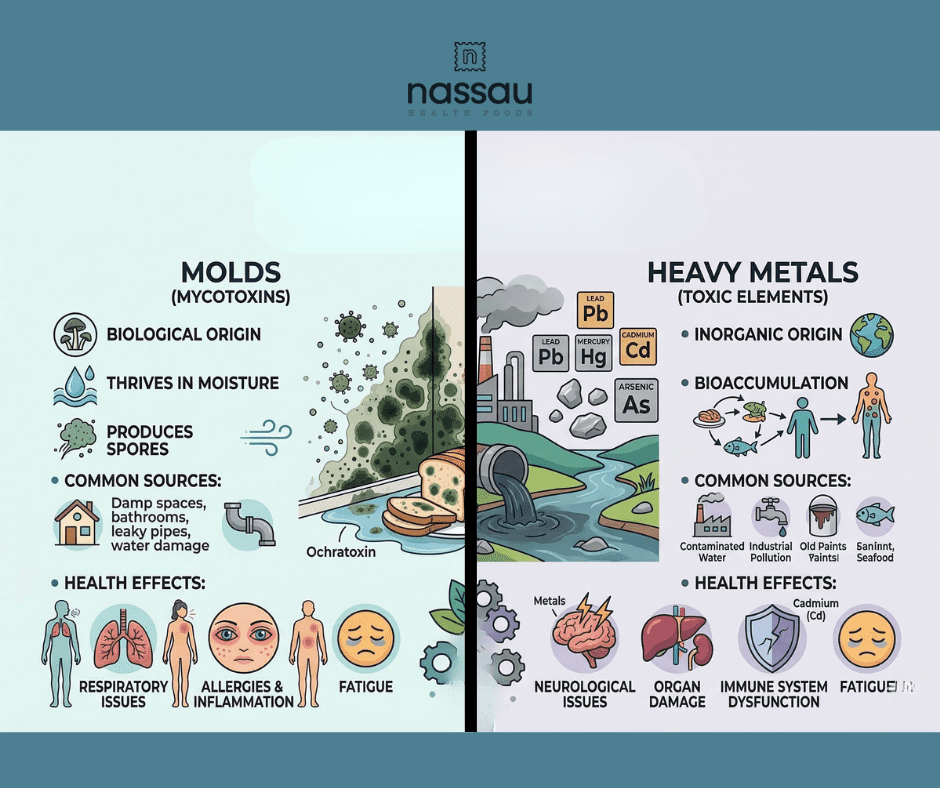
Toxin burden refers to the accumulation of harmful substances in the body over time.

According to the transcript, these substances can come from multiple sources, including:

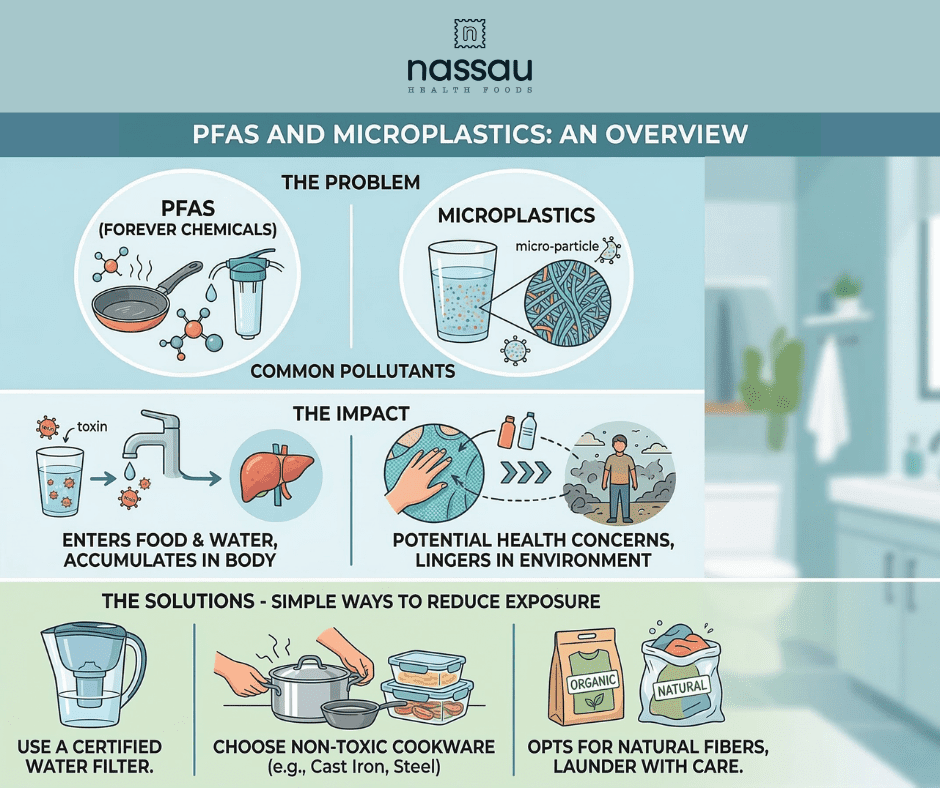
  • Microplastics
  • PFAS (often called “forever chemicals”)
  • Mold toxins
  • Heavy metals such as mercury

These toxins don’t simply pass through the body and disappear. Many are resistant to breakdown and can accumulate in tissues, organs, and systems over years or decades.

Steve explains that while there is debate in public discussions about how significant some of these exposures are, real-world testing inside a medical clinic shows that these substances are indeed being found in people’s bodies.


Microplastics: Small Particles, Big Questions

Microplastics are tiny plastic particles that can enter the body through everyday behaviors, such as:

  • Drinking from plastic containers
  • Eating food that has been heated in plastic

The transcript acknowledges that debate exists about the evidence base around microplastics. However, Steve shares that in a clinical setting, microplastics are being found in patients’ bodies—suggesting that exposure is real and widespread.

If these particles are showing up consistently in medical testing, it raises a reasonable concern: they’re coming from somewhere, and many people may already be carrying them without knowing it.


PFAS: The Problem With “Forever Chemicals”

One of the most detailed sections of the episode focuses on PFAS, which stands for per- and polyfluoroalkyl substances.

These chemicals are often referred to as “forever chemicals” because:

  • They are extremely resistant to breaking down
  • They persist in the environment
  • They accumulate in living organisms over time

According to the transcript, PFAS have been used since the 1940s and are found in many everyday products, including:

  • Non-stick cookware
  • Food packaging
  • Stain-resistant carpets and clothing
  • Firefighting foams
  • Industrial applications such as aerospace and electronics

Because these chemicals repel water, oil, grease, and stains, they became widely used—but their durability is also what makes them problematic.

Steve explains that PFAS can accumulate in soil, water, animals, and humans, and they are increasingly a subject of concern in medical research.


Mold Toxins and Heavy Metals

Beyond plastics and PFAS, the transcript also highlights two additional sources of toxin burden:

Mold Toxins

Mold exposure can contribute to overall toxin load in the body, particularly when exposure is chronic or unresolved.

Heavy Metals

Metals such as mercury are also being found in patients through medical testing. These metals are linked, according to the transcript, to increased risks related to cancer and metabolic disease.


How Toxins Affect the Body

The episode explains several mechanisms through which toxin burden can negatively impact health.

1. Oxidative Stress

Oxidative stress is described as “rust inside the body.”
It damages cells and tissues and reduces the body’s ability to repair itself over time.

2. Chronic Inflammation

Persistent inflammation is identified as a core contributor to many diseases. Toxins can trigger and sustain this inflammatory response, creating an internal environment that increases disease risk.

3. DNA Damage and Cancer Risk

Toxins can cause DNA damage, leading to mutations and genomic instability. This process may initiate carcinogenesis, where normal cells begin to grow uncontrollably.

Some chemicals also act as endocrine disruptors, interfering with hormonal balance and potentially promoting cancers such as breast and prostate cancer.


Toxins and Metabolic Disease

The transcript draws a clear connection between toxin exposure and metabolic dysfunction.

Insulin Resistance

Exposure to certain toxins can impair insulin signaling, leading to insulin resistance. This condition is described as a precursor to:

  • Type 2 diabetes
  • Metabolic syndrome

Altered Lipid Metabolism

Toxins can disrupt lipid metabolism, leading to abnormal lipid levels (dyslipidemia), which increases the risk of:

  • Cardiovascular disease
  • Fatty liver disease

Weight Gain and Obesity

Toxin burden may also contribute to weight gain by altering:

  • Hormonal regulation of appetite
  • Fat storage
  • Metabolic function

Obesity itself is identified as a significant risk factor for diabetes, cancer, and blood pressure issues.


Nutrient Absorption and the Gut

Another important point from the transcript is how toxins can impact the gut.

High toxin burden can:

  • Disrupt the gut microbiome
  • Affect the digestive tract
  • Impair nutrient absorption

Steve shares a personal example of discovering a vitamin C deficiency—despite living in the United States—highlighting how toxin-related gut dysfunction can contribute to nutrient deficiencies.


Health Span vs. Life Span: Why This Matters as You Age

The episode shifts toward a broader perspective on aging and quality of life.

According to the transcript:

  • The average life expectancy in the U.S. is 77 years
  • The average health span is 66 years
  • This leaves roughly 11 years spent managing chronic disease

Steve poses a direct question: do you want to spend those years limited by conditions like cancer, diabetes, hypertension, or cardiovascular disease?

Especially in a place like Amelia Island—known for its beauty, community, and active lifestyle—the goal is not just to live longer, but to stay healthy longer.


Why Detoxing Requires Medical Guidance

One of the most important cautions in the episode is about detoxing.

Steve explains that removing toxins from the body is not something to do casually. Without proper binding, releasing toxins can make people very sick. This is why he emphasizes detox protocols should be done under the care of a physician.

He shares that he has personally gone through this process under medical supervision and describes it as transformative—but reiterates that it must be done safely.


Lifestyle Choices That Support Long-Term Health

The episode outlines several habits that are positioned as critical for aging well:

  • Reorganizing your relationship with stress, including diaphragm breathing
  • Prioritizing sleep, especially deep and REM sleep
  • Eating less and fasting more, including a 13-hour daily fast
  • Moving your body every day, such as walking for 25 minutes
  • Eating clean food

Steve emphasizes that food can either be medicine or poison—and frames clean food as an investment in long-term health, even if it costs more upfront.


Stopping the Addition of New Toxins

One of the strongest takeaways from the transcript is this idea:

Detoxing isn’t just about removing toxins—it’s also about stopping new ones from coming in.

This includes:

  • Products you put on your skin
  • Products you put in your mouth

Steve shares his personal commitment to eliminating products that weren’t toxin-free and explains that Nassau Health Foods exists to help people make those choices more easily.


A Community-Focused Message

The episode closes with a reminder that this conversation isn’t just about promoting a store—it’s about community health.

The tools exist. The support exists. Whether through Nassau Health Foods, local staff, or medical professionals, help is available.

The message is simple: do something.

Read Series 2, Part 1 here: https://nassauhealthfood.com/ep64-how-toxins-quietly-shorten-your-health-span/ 

Read Series 2, Part 2 here: https://nassauhealthfood.com/ep65-reduce-toxic-exposure-what-water-skin-and-everyday-products-are-doing-to-your-body-series2-part2/

Watch the full episode here: https://youtu.be/aSIYi-GrUeU

Shop online anytime at:
👉 https://nassauhealthfood.com/
Or visit us at:
📍 833 T.J. Courson Rd.
Fernandina Beach, FL 32034

Transcript Evidence

All claims, explanations, examples, and language in this blog post are derived directly from the EP 63 podcast transcript provided by the user. No external sources, studies, statistics, or interpretations were added.

EP 62: Healthspan > Lifespan: Why the Quality of Your Years Matters More Than How Long You Live

“Food is medicine—or it’s poison.

Nassau Health Foods

Welcome to the Organic Living Secrets Podcast

Hi, I’m Steve Adams—owner of Nassau Health Foods on Amelia Island, Florida—and welcome to the Organic Living Secrets podcast.

If you live on Amelia Island or anywhere in Nassau County (Northeast Florida near the Georgia border), I want you to think of this podcast as yours. It’s built around the people and the pace of life here—morning beach walks, downtown Fernandina charm, community events, and the kind of everyday moments you want to enjoy for as long as possible.

And that brings us to the point of this show.


My Story: Why I Care So Much About “Healthspan”

Before I owned a health food store, I spent years as a corporate banker and then 21 years helping grow a chain of nearly 50 pet stores. In 2017, I exited that business—largely because my health had declined and I wanted to be proactive about changing the trajectory of my life.

I come from a family with shorter lifespans and poor health outcomes. I didn’t want that story to repeat—for me, and for my children and grandchildren.

That’s when I worked with a naturopathic MD and went through a functional medicine approach: reverse-engineering health from a root-cause perspective. Over time, it helped me rebuild my health to the point that, in my early 60s, I genuinely feel better than I did in my 40s.


Healthspan vs Lifespan: The 11-Year Wake-Up Call

In the intro episode, I share a simple concept that changes how you think about aging:

  • Lifespan = how long you live
  • Healthspan = how many of those years you live healthy, active, and fully able to enjoy life

In the episode, I reference a commonly used example: an average lifespan of about 77 years and an average healthspan of about 66 years—meaning the last ~11 years can be compromised by chronic health challenges.

Whether your personal “gap” is 11 years or more, the takeaway is the same:

We want to compress that gap.
Not just live longer—live better for longer.


Why Nassau Health Foods Calls You a “Client,” Not a “Customer”

At Nassau Health Foods, we don’t think of our relationship with you as transactional.

A “customer” buys a product.
A “client” is someone we guide, with your best interest at heart.

That’s why we invest in knowledgeable people, curated product selection, and an environment where you can actually ask questions and get support.


Clean Living Starts at the Cellular Level

One of the ideas I’ve learned through Tiger Medical Institute is that cellular health has key drivers. When your cells are supported, your tissues are supported, your organs are supported—and your whole body benefits.

In the episode, I mention three foundational pillars:

  • Lower oxidative stress
  • Lower inflammation
  • A healthier internal environment for your cells to thrive

That’s why clean food and clean household/wellness products matter—not as “trends,” but because they reduce long-term burden on the body.

Or said another way:

Food is medicine… or it’s poison.


“Clean Costs More”… But Getting Sick Costs More

Yes, clean living can cost more upfront. Quality ingredients, better sourcing, and a staffed store that can actually help you—those aren’t free.

But the tradeoff is real:

It costs more to get sick.

And if you’re over 50, the biggest risk for most people isn’t a financial crisis—it’s a sudden health decline that changes everything.


Here’s the Point: No One Will Do This For You

Insurance will keep you alive. It won’t build your healthspan.

Medicare won’t become your health coach.
Blue Cross won’t plan your meals.
United won’t teach you how to lower your toxin load.

This depends on you.

And here’s the encouraging part: if you’ve built a life that allows you to live in a place like Amelia Island, you’ve already done hard things. You can do this too.


What’s Coming on the Podcast

I’m excited about the future of this show—because going forward, Dr. Daniel Kessler will join me weekly. He’s a functional medicine physician, Mayo-trained, and trained in the Swiss Biologic Method, which focuses on detox and creating a healthier cellular environment.

Together, we’ll unpack topics you can learn and apply—whether or not we sell the solution in our store. Because the real goal is simple:

Nassau Health Foods should be a resource center for community health.


Subscribe and Join Us

If you want to protect your healthspan—and keep enjoying the beach walks, downtown events, travel, time with grandkids, and the life you’ve built—subscribe to the Organic Living Secrets podcast.

And if you’re local, come visit us at Nassau Health Foods. We’re grateful for your support and excited for what’s coming in 2026.

Subscribe now—and let’s live better, longer.

Subscribe here: https://podcasts.apple.com/us/podcast/organic-living-secrets-amelia-island-by-nassau-health/id1773754456


Nassau Health Foods
Locally trusted since 1985.

Shop all things organic herehttps://nassauhealthfood.com/ 

EP 61: From Exhausted to Energized: How to Reset Your Health Before the New Year

𝘠𝘰𝘶 𝘥𝘰𝘯’𝘵 𝘯𝘦𝘦𝘥 𝘢 𝘴𝘵𝘳𝘪𝘤𝘵𝘦𝘳 𝘳𝘰𝘶𝘵𝘪𝘯𝘦. 𝘠𝘰𝘶 𝘯𝘦𝘦𝘥 𝘢 𝘴𝘵𝘳𝘰𝘯𝘨𝘦𝘳 𝘧𝘳𝘢𝘮𝘦𝘸𝘰𝘳𝘬.”

Nassau Health Foods

There’s something sacred about the final weeks of the year.

The light feels softer.
Your routines slow down.
Your inner voice gets quieter—but clearer.

And somewhere between your final grocery run and the last coffee of the year, you hear a subtle whisper:

“Next year, I want to feel different.”

Not overwhelmed.
Not exhausted.
Not stuck in the same cycle of starting strong and losing momentum.

You want energy.
You want clarity.
You want a plan you can actually keep.
And more than anything—you want 2026 to feel aligned with who you are becoming.Here’s the truth:
You can absolutely have that.
But only if you stop repeating the one mistake most people make every January…


❌ WHY MOST NEW YEAR RESOLUTIONS FAIL (AND IT’S NOT YOUR FAULT)

Every year, millions of people make resolutions:

  • “I’m going to eat clean.”
  • “I’m starting a new diet.”
  • “I’ll take supplements every day.”
  • “I’m going to the gym five times a week.”

And by mid-February, most of those goals… quietly disappear.

But here’s what no one tells you:

“Resolutions don’t fail because you lack discipline.

They fail because you lack a framework.”

Most people enter the new year with pure intentions but no structure.

They have tactics…
but not a system.
They have motivation…
but not a roadmap.
They have desire…
but not the support to make it sustainable.

This is especially true here in small-town communities like Amelia Island, where:

  • Healthy dining options are very limited
  • Organic groceries can feel expensive or hard to find
  • Doctors often won’t order labs unless symptoms appear
  • People distrust supplements because they’re overwhelmed by choices
  • Families are juggling long workdays, caregiving, retirement plans, and holiday pressure

(These frustrations are backed by real small-town consumer pain points. )

So people begin with beautiful intentions…
but no pathway to success.

To start 2026 strong, you don’t need another resolution.
You need a reset—one rooted in clarity, simplicity, and consistent support.

Let’s walk through the 3 pillars of your Year-End Wellness Reset.


🌟 PILLAR 1: CLARITY — KNOW WHAT YOUR BODY ACTUALLY NEEDS

The fastest way to lose momentum is to start a wellness journey with no map.

And most people enter January guessing:

  • Guessing which supplements matter
  • Guessing which foods give energy
  • Guessing whether fatigue is normal
  • Guessing how healthy their heart really is
  • Guessing what’s happening beneath the surface

But you deserve better than guessing.

You deserve clarity.

Clarity is what transforms overwhelm into empowerment.
It’s the difference between “I hope this works” and “I know what my body needs.”

This is why preventative screenings—especially the Glycocheck microvascular screening—are game-changers.
They reveal how your heart and endothelial system are aging long before a traditional doctor would ever say something is wrong.

Because the truth is:

By the time symptoms appear, you’re already behind.
— NHF Preventative Wellness Insight

This is why Nassau Health Foods invested in offering in-store preventative screenings for the community—because locals deserve early detection, not late intervention.

Your Year-End Reset begins here:
Know your numbers.
Know your health.
Start 2026 informed, not overwhelmed.


🌿 PILLAR 2: SIMPLICITY — REMOVE THE DECISION FATIGUE

Here’s a secret many health professionals don’t talk about:

Decision fatigue—not laziness—is why most wellness plans fall apart.

Think about your week.

“How do I eat healthy today?”
“Is this label clean?”
“What do I make for dinner?”
“Does my family even like healthy food?”
“Do we have snacks for the kids?”
“Do I have time to prep anything?”

Every question drains your motivation.

By Thursday, you’re exhausted—not from living unhealthy, but from thinking about health all day.

This is where most New Year resolutions die.

Which is why Nassau Health Foods created Webcart, our online grocery delivery + pickup system designed exactly for busy families, retirees, and wellness-conscious locals who need healthy eating to be easy.

Webcart Removes the Hardest Part of Eating Clean:

  • No label reading
  • No guesswork
  • No confusing supplement aisles
  • No wondering “what’s for dinner?”
  • No hour-long drive to Whole Foods

Our curated bundles are built to eliminate overwhelm with:

✔ Weekly staples
✔ Immune-boosting essentials
✔ Family-friendly favorites
✔ Gluten-free + vegan options
✔ Heart-healthy selections
✔ Anti-inflammatory essentials

This isn’t just shopping.
This is strategic simplicity.

When healthy eating becomes easy,
consistency becomes inevitable.

And that’s how you start 2026 with momentum.


💛 PILLAR 3: SUPPORT — BECAUSE WILLPOWER ISN’T THE ANSWER

If you’ve ever said:

  • “I know what to do—I just don’t do it consistently”
  • “I start strong, then fall off”
  • “I’m too busy to stay on track”

…you’re not alone.

“And you’re not the problem.

Your system is.”

No one succeeds alone—not in fitness, not in business, not in health.

Support is what carries you when life gets stressful.
Support is what guides you when you’re unsure what to do next.
Support is what keeps you consistent when motivation dips.

And that’s why we created the Thrive Wellness Membership at Nassau Health Foods.

Thrive Gives You:

  • Monthly wellness check-ins
  • Cardiometabolic health scoring
  • Personalized nutrition guidance
  • Discounts on supplements
  • Discounts on screenings
  • Accountability from a team that knows you by name
  • A framework that grows with you all year long

This isn’t a membership.
This is a movement toward sustainable, preventative wellness—something most residents in small-town communities have never had access to before.

Your Year-End Reset becomes powerful when it’s supported consistently.


🔄 HOW THESE 3 PILLARS WORK TOGETHER

When you combine:

Clarity + Simplicity + Support

you create a wellness rhythm that lasts all year—not just for a few weeks.

Here’s how it looks in real life:

Step 1:

You begin the year with real data from your screenings.

Step 2:

You remove all guesswork from eating with Webcart and the Café.

Step 3:

You stay consistent because Thrive guides your next steps.

This is the framework that will help you start 2026 strong—
not burned out, not confused, and not alone.


🌞 THE YEAR YOU WANT IS POSSIBLE (AND BEAUTIFUL)

Imagine this:

It’s early March.
You’re walking the beach at sunrise.
The air is crisp, the sky soft, your body light.

You feel good.
Clear.
Energized.
Proud.

Not because you “pushed harder”…
but because you built a wellness framework that supported you.

Your fridge is stocked with Webcart staples.
Your heart health feels monitored and understood.
Your energy feels stable and effortless.
Your monthly Thrive check-in reminds you you’re not alone.
Your café lunches feel nourishing and joyful.
Your supplements actually make sense now.

You’re in control—not perfect, not pressured—
but in a steady rhythm that feels aligned with the life you want.

That’s the magic of a reset that works.


🎁 THE YEAR-END WELLNESS RESET PROMOTION

To help you step into 2026 with intention, Nassau Health Foods is offering a special year-end promotion built around this exact framework:

Join the Thrive Membership
Get the guidance, accountability, and structure that make consistency simple.

Book Your Preventative Screening
Know your numbers.
Understand how your body is aging.
Start your health journey with clarity.

Shop with Webcart
Order curated grocery bundles that save you time, stress, and energy.


YOUR NEW YEAR BEGINS WITH ONE CHOICE

You deserve a year where your health feels effortless—not stressful.
Supported—not confusing.
Proactive—not reactive.

This is your moment.
Your pause.
Your chance to step into a new year with confidence and clarity.

Your Year-End Wellness Reset starts today.
And Nassau Health Foods is honored to walk with you every step of the way.


Nassau Health Foods
Locally trusted since 1985.

Shop all things organic herehttps://nassauhealthfood.com/ 

EP 60: The 3-Point Checklist Every Supplement User Needs

𝘠𝘰𝘶 𝘥𝘪𝘥𝘯’𝘵 𝘧𝘢𝘪𝘭 𝘺𝘰𝘶𝘳 𝘴𝘶𝘱𝘱𝘭𝘦𝘮𝘦𝘯𝘵 — 𝘺𝘰𝘶𝘳 𝘴𝘶𝘱𝘱𝘭𝘦𝘮𝘦𝘯𝘵 𝘧𝘢𝘪𝘭𝘦𝘥 𝘺𝘰𝘶.”

Nassau Health Foods

Almost every health-conscious person on Amelia Island has stood in front of their supplement cabinet with that same familiar wave of doubt:

“I’ve been taking this for months… why don’t I feel anything?”
“Am I wasting money?”
“How do I know this is even real?”

Good questions.
Smart questions.
And questions you absolutely deserve answers to.

Because in small communities like ours — where Whole Foods, Sprouts, and natural pharmacies are an hour away — it’s easy to end up buying supplements that… well… don’t actually do much.

Here’s the empowering news:

You’re not confused.
You’re unsupported.
And we’re going to fix that today.

This article breaks down the three ways to know if a supplement actually works, the most common reasons people don’t feel results, and how Nassau Health Foods’ supplement consults + Revasca give you clarity you can trust.

By the end, you’ll know exactly how to choose supplements that match your body, your goals, and your life.


The Real Reason Most People Never “Feel” Their Supplements

Here’s the hard truth most people never hear:

Most supplements don’t “not work”…
they’re simply not the right supplement for the right person.

And it’s not your fault.

The supplement industry is confusing, unregulated, and filled with marketing language that means almost nothing.

Most people end up:
• Buying whatever is trending
• Following influencer advice
• Copying a friend’s routine
• Buying cheap versions
• Trying 8 things at once
• Hoping for the best

Then they blame themselves when nothing changes.

But the truth?
You’re not the problem.

The problem is this:

Most supplements fail for 3 reasons:

  1. They’re not third-party tested
  2. They’re not bioavailable
  3. They’re not matched to your real root issue

Fix those three things, and your entire experience with supplements changes.

Let’s walk through them.


Step 1: Is Your Supplement Third-Party Tested?

(If not… stop taking it.)

This is the most important question you can ask.

What most people don’t realize:

Supplement companies do not have to prove purity.
They do not have to prove potency.
They do not have to prove what’s actually in the bottle.

They can put almost any phrase on a label:
• “Pure”
• “Clinically formulated”
• “High potency”
• “Advanced blend”

None of it has to be verified.

This is why so many people say:

“Supplements are a scam.”
“I don’t trust these labels.”
“I feel like I’m throwing money away.”

Here’s the truth:
They’re not wrong.
Not all supplements are real.
Not all supplements are safe.
And not all supplements contain what they claim.

So how do you protect yourself?

You ONLY buy supplements that are:

✓ Third-party tested by an independent lab

Meaning:
• The ingredients are verified
• The dose is real
• Heavy metals are screened
• Contaminants are checked
• The product is safe
• The label is honest

This one filter alone eliminates 80% of the supplement aisle.

At Nassau Health Foods, we curate ONLY third-party-tested brands — because you deserve clarity, not gambling.

Our community trusts us because we’ve done the research for you.
You don’t have to guess.
You don’t have to Google until midnight.
You don’t have to hope the supplement is real.

You can finally walk into a store and feel confident:
“Everything here is vetted.”


Step 2: Is Your Supplement Bioavailable?

Great.
So it’s real.
But now the second question:

Can your body actually absorb it?

Bioavailability means absorption — and absorption determines EVERYTHING.

Here’s why most people don’t feel results:

“They’re taking the right nutrient…

but the wrong form.”

Examples:

👉 Magnesium oxide (cheap)

Absorption: ~4%
Energy & relaxation impact: almost zero

👉 Magnesium glycinate/malate (bioavailable)

Absorption: high
Real benefits: improved sleep, muscle relaxation, calmer mood

Same nutrient.
Completely different experience.

Another example:

👉 Synthetic B-vitamins (cheap)

Poor absorption
Minimal effect

👉 Methylated B-vitamins (bioavailable)

Body-ready
Massive energy impact

When you pick low-quality or low-absorption forms, you can take them for months and feel nothing.

This leads to the classic supplement complaint:

“These vitamins don’t do anything for me.”

But the real issue was never the vitamin — it was the form.

At NHF, our team hand-selects supplements based on what your body actually absorbs, not what looks good on a label.

When a supplement is bioavailable, you feel it — not like caffeine or a stimulant, but like deeper calm, steadier energy, better sleep, sharper thinking, and healthier labs.


Step 3: Is the Supplement the Right Fit for YOU?

Here’s the part no one talks about.

**Even a perfect supplement won’t work…

if it doesn’t match your real need.**

This is where most people accidentally sabotage their progress.

Common example:

You take probiotics for bloating.
But the real issue is SIBO.
Probiotics make it worse, not better.

Another example:

You take magnesium for sleep.
But your sleep problem is cortisol, not magnesium deficiency.

Another example:

You buy a heart supplement off Amazon.
But what you really need is endothelial support — not CoQ10.

This leads to frustration:
“I’ve tried everything and nothing works.”

No — you’ve tried everything…
except a plan tailored to your body.

This is why NHF’s supplement guidance consults are game-changing.

We help you identify:
• The real issue behind your symptoms
• What your body actually needs
• Which supplements fit your goals
• What forms are best
• What dose actually works
• What to take together
• What to stop wasting money on

You walk out with a plan, not a guess.

And the difference is life-changing.


Why Revasca Is the Supplement Our Community Actually Feels

After thousands of conversations with locals, one theme kept coming up:

“I want more energy, better heart health, and a solution that actually works.”

That’s why we brought in Revasca — a heart and microvascular support formula designed for:

• Healthy circulation
• Improved nutrient delivery
• Endothelial support
• Energy production
• Aging gracefully
• Cardiovascular resilience

Revasca works because it solves all three issues:

✓ It’s third-party tested

Verified purity. Verified potency. Zero guesswork.

✓ It’s bioavailable

Your body absorbs it. No wasted nutrients.

✓ It’s targeted to the #1 issue on Amelia Island

Microvascular decline and energy.

It’s the supplement people come back for and say:
“I actually feel a difference.”
“My brain fog lifted.”
“My energy is steadier.”
“I don’t feel as heavy and sluggish.”

When you pair Revasca with a Glycocheck screening — our 15-minute vascular test — you go from guessing to understanding.

For the first time ever, you can see your microvascular health:
• How well your capillaries are functioning
• How efficiently nutrients get delivered
• How your endothelial layer is aging
• Whether inflammation is affecting circulation

It’s the missing link for so many locals who feel “off” but don’t get answers from traditional medicine.


What Most People Really Need: A Guide, Not More Pills

Here’s the truth:

People don’t fail supplements.
Supplements fail people —
when there’s no guidance.

Your body is unique.
Your lifestyle is unique.
Your goals are unique.

You deserve a plan that reflects that.

Nassau Health Foods is not just a store.
We are your trusted local wellness guide, fully aligned with what our community actually needs:

• Clean ingredients
• Clear explanations
• Honest guidance
• Lab-tested brands
• Proactive prevention
• Personalized plans
• A place where you’re known by name

You shouldn’t have to drive an hour to Jacksonville or sift through thousands of sketchy Amazon listings to take care of your health.

You have everything you need right here — local, trusted, and curated with care.


How to Tell if YOUR Supplements Are Working Today

Here are three quick questions you can ask yourself right now:

Question 1 — Is my supplement third-party tested?

If not, it’s a no.

Question 2 — Is it the bioavailable, body-ready form?

If not, the dose doesn’t matter.

Question 3 — Was it selected for my unique goals and symptoms?

If not, it won’t work for you.

When all three are “yes,” supplements do work — consistently, safely, and meaningfully.

When any one of them is a “no,” you’re wasting time and money.

You deserve better than that.


Your Next Step: Choose Clarity, Not Guesswork

If you’re tired of guessing…
Tired of wasting money…
Tired of not feeling a difference…

Here’s what to do next:


1. Get a Free Supplement Guidance Consult

Stop by Nassau Health Foods and bring:
• Your bottles
• Your list
• Your symptoms
• Your goals

Our team will help you choose what works — and eliminate what doesn’t.


2. Ask About Revasca

If you want:
• More energy
• Better circulation
• Heart health support
• A supplement you’ll actually feel

Revasca is in-store now.


3. Book Your Glycocheck Screening

If you want measurable insights into your microvascular health, this 15-minute test will show you what’s going on inside — long before symptoms appear.


4. Join the Thrive Membership

Your proactive health plan:
• Monthly check-ins
• Discounts on supplements
• Personalized support
• Member-only perks
• A roadmap tailored to you


You Deserve Supplements That Work for YOU

Wellness is confusing when you’re navigating alone.
But clarity is easy when you have a local guide.

At Nassau Health Foods, we make healthy living simple, trustworthy, and personal — just like it should be.

Because your wellness shouldn’t be a guessing game.
And you deserve a team that knows you by name, understands your goals, and helps you choose supplements with confidence.


Nassau Health Foods
Locally trusted since 1985.

Shop all things organic herehttps://nassauhealthfood.com/ 

EP 59: The Ultimate Flu-Season Pantry: What to Buy, Why It Works, and How to Use It

𝘠𝘰𝘶𝘳 𝘪𝘮𝘮𝘶𝘯𝘦 𝘴𝘺𝘴𝘵𝘦𝘮 𝘪𝘴𝘯’𝘵 𝘧𝘳𝘢𝘨𝘪𝘭𝘦 — 𝘪𝘵’𝘴 𝘳𝘦𝘴𝘱𝘰𝘯𝘴𝘪𝘷𝘦. 𝘍𝘦𝘦𝘥 𝘪𝘵 𝘸𝘦𝘭𝘭. 𝘚𝘶𝘱𝘱𝘰𝘳𝘵 𝘪𝘵 𝘥𝘢𝘪𝘭𝘺”

Nassau Health Foods

Every year, Amelia Island experiences the same pattern: cooler mornings, busier cafés, and then—out of nowhere—the first wave of coughing coworkers and sniffling kids.

But here’s the truth most people don’t know:

Your immune system doesn’t respond to flu season… it prepares for it.

In other words:
You can strengthen your immunity long before the first sneeze circulates around town.

And for health-conscious locals—busy moms, active retirees, remote workers, and snowbirds—the goal isn’t fear.
It’s proactive vitality.
(It’s exactly what NHF’s brand voice exists to champion. )

In this guide, you’ll discover:

  • The most effective immune-boosting foods (all available locally at NHF)
  • How to build a flu-season pantry that actually works
  • The truth about gut health + immunity
  • Easy recipes using immune-focused ingredients
  • How NHF Immune Bundles and supplement consults save you time, money, and confusion

This is health without the hassle.
This is the Nassau Health Foods way.


Why Preparing Before Flu Season Matters

Most people think immunity is passive.
That it’s something that “happens” to you.

But your immune system is less like a fire alarm…
and more like a garden.

It doesn’t activate when things go wrong.
It develops based on daily nourishment.

This is where most locals feel stuck:
“I want to stay healthy, but I don’t know where to start.”

What they’re really dealing with isn’t laziness—it’s decision fatigue.
(You’ve mapped this belief shift in your brand strategy. )

The solution: a simple pantry. Clean foods. Trusted supplements.
A wellness plan any family can follow.

Let’s start with the foods that matter most.


The Most Powerful Immune-Boosting Foods You Can Buy on Amelia Island

1. Vitamin C Powerhouses

Vitamin C is immunity’s activation switch. It helps shorten severity and duration of illness.

Top picks at NHF:

  • Organic citrus: lemons, oranges, grapefruit
  • Red and yellow bell peppers
  • Frozen or fresh berries
  • Camu camu powder (for mega-dose support)

These foods give your body the raw materials it needs to respond fast.


2. Natural Antivirals & Antibacterials

Garlic

Rich in allicin, a compound shown to combat viruses and bacteria.

Ginger

Supports circulation, reduces inflammation, and helps digestion—an immune trifecta.

Raw local honey

A soothing antimicrobial with natural enzymes. Amazing in teas, tonics, and even dressings.

Turmeric

One of the most research-backed anti-inflammatories.

Green Tea

Packed with catechins that strengthen immune cell activity.

These are the foods your grandmother trusted—and for good reason.


3. The Gut-Health Category (The Most Underrated Immune Tool)

Here’s the stat most people don’t know:

Approximately 70% of your immune system lives inside your gut.

If your gut is sluggish, inflamed, or lacking healthy bacteria… immunity takes the hit.

At NHF, locals regularly express frustration over poor healthy dining options in the area—especially anything gut-friendly.

That’s why our curated probiotic section is so beloved.

Top gut-supporting immune foods:

  • Raw sauerkraut
  • Coconut or dairy-free probiotic yogurt
  • GT’s Kombucha (which locals literally struggle to find elsewhere)
  • Miso and fermented foods
  • Bananas, apples, onions, asparagus (prebiotics that feed good bacteria)

Combine probiotic + prebiotic foods and your gut becomes an immune fortress.


4. Anti-Inflammatory Staples

Chronic inflammation is like static noise—your immune system has to fight through it before fighting actual viruses.

Best anti-inflammatory foods at NHF:

  • Leafy greens: kale, spinach, arugula
  • Olive oil (cold-pressed, vetted brands)
  • Avocado
  • Omega-3 foods: walnuts, chia, flax, salmon
  • Herbal teas (ginger, turmeric, green tea)

These foods calm the system so your immunity can work efficiently.


5. Hydration + Mineral Support

Hydration keeps your lymphatic system moving—your body’s “immune transportation” network.

Stock these:

  • Coconut water
  • Electrolyte packets or mineral drops
  • Herbal teas
  • Broths (mineral-rich, soothing, hydrating)

Hydration may be the simplest flu-season strategy, yet the most overlooked.


How to Build a Flu-Season Pantry That Works (Not Overwhelms You)

Your NHF Content Framework shows it clearly:
people don’t struggle because they lack motivation—they struggle because they lack a framework.

So here is the pantry system that eliminates overwhelm:


🟩 THE 3-SHELF FLU-SEASON PANTRY SYSTEM

SHELF 1: Daily Immune Builders

(Use every single day)

  • Organic citrus
  • Raw honey
  • Ginger
  • Garlic
  • Greens
  • Berries
  • Olive oil
  • Tea

These keep your immune system active, not dormant.


SHELF 2: Symptom Boosters

(Use at first sign of sniffles)

  • Bone broth or vegan mineral broth
  • Vitamin C powders
  • Zinc + elderberry
  • Ginger tea
  • Turmeric shots
  • Coconut water
  • Probiotic-rich foods

This shelf acts as your “early intervention kit.”


SHELF 3: Long-Term Preventatives

(Keeps you strong all season)

  • Frozen produce
  • Gluten-free oats
  • Quinoa, lentils
  • Green tea
  • Chia, flax, walnuts
  • Clean protein sources
  • Shelf-stable soups and broths

These staples allow you to stay consistent, even on the busiest weeks.


NHF Immune Support Bundles — The Easiest Way to Get It Right

One of the biggest frustrations NHF customers express is the lack of trustworthy supplement guidance in big chain stores.

People waste money on low-quality products or random combinations that don’t work together.

The NHF solution?

Immune Support Bundles designed for Amelia Island living.

Each bundle includes:

  • High-quality Vitamin C
  • Zinc + Elderberry
  • Vitamin D3 + K2
  • Probiotic
  • Optional mushroom immune blend
  • Optional turmeric curcumin capsules

And the best part?

Every bundle includes a complimentary supplement consult.

Because NHF’s brand promise is not just:
“Clean ingredients.”
It’s also:
“Clear guidance.”

No guesswork.
No overwhelm.
Just personalized support for your immune season.


Extra Prevention for Those Who Want Maximum Protection

Some guests at NHF love going deeper into prevention. They’re proactive, informed, and ready for more advanced tools.

Here are the top flu-season upgrades:

1. Glycocheck Microvascular Screening

This test gives you early insight into inflammation and vascular decline—long before symptoms develop.

2. Thrive Wellness Membership

Monthly check-ins, personalized nutrition plans, discounts on supplements, and wellness monitoring.
Perfect for active retirees and high-achieving locals.

3. Revasca

A breakthrough supplement for endothelial and vascular support—foundational for immune health.

These aren’t mandatory—but they massively elevate your wellness trajectory.


Easy Immune-Boosting Recipes (Perfect for Busy Locals)

1. Morning Honey-Lemon-Ginger Tonic

  • 12 oz warm water
  • Juice of ½ lemon
  • 1 tsp raw local honey
  • 1-inch slice ginger
  • Optional: cayenne

2. Immune Veggie Soup

  • Garlic + onions sautéed
  • Carrots, celery, kale
  • Turmeric, black pepper
  • Bone broth
  • Lemon to finish

3. Citrus & Avocado Immunity Salad

  • Mixed organic greens
  • Orange or grapefruit slices
  • Avocado
  • Red onion
  • Olive oil + lemon dressing

4. Berry Antioxidant Smoothie

  • Frozen berries
  • Coconut water
  • Banana
  • Camu camu powder
  • Chia seeds

These recipes hit your pantry categories effortlessly.


Your Immune Reframe for 2025

Your immune system is not fragile.
It’s responsive.
It’s adaptable.
And it’s always listening to the choices you make.

This flu season, you don’t need perfection.
You just need preparation.

With the right pantry system, clean foods, trusted supplements, and NHF guidance, you can build a winter that feels:

  • Strong
  • Clear
  • Energized
  • Nourished
  • Resilient

Exactly what your audience seeks: proactive wellness and sustainable vitality.


Your Next Step Is Simple

Visit Nassau Health Foods this week.

Stock your flu-season pantry.
Grab your NHF Immune Support Bundle.
Book your free supplement consult.

Because here on Amelia Island, your health should be: Local. Trusted. Simple.


Nassau Health Foods
Locally trusted since 1985.

Shop all things organic herehttps://nassauhealthfood.com/ 

Your map to healthy eating.

Conveniently located near the beach and downtown.

Mon-Fri: 8am – 7pm

Sat: 8am – 6pm

Sun: 10am – 4pm

Tel: (904) 277-3141

Mon-Fri: 11am – 3pm

Closed on Saturday & Sunday

Tel: (904) 277-3141

Order Online

Mon-Fri: 8am-11am

Closed on Saturday & Sunday

Get Directions