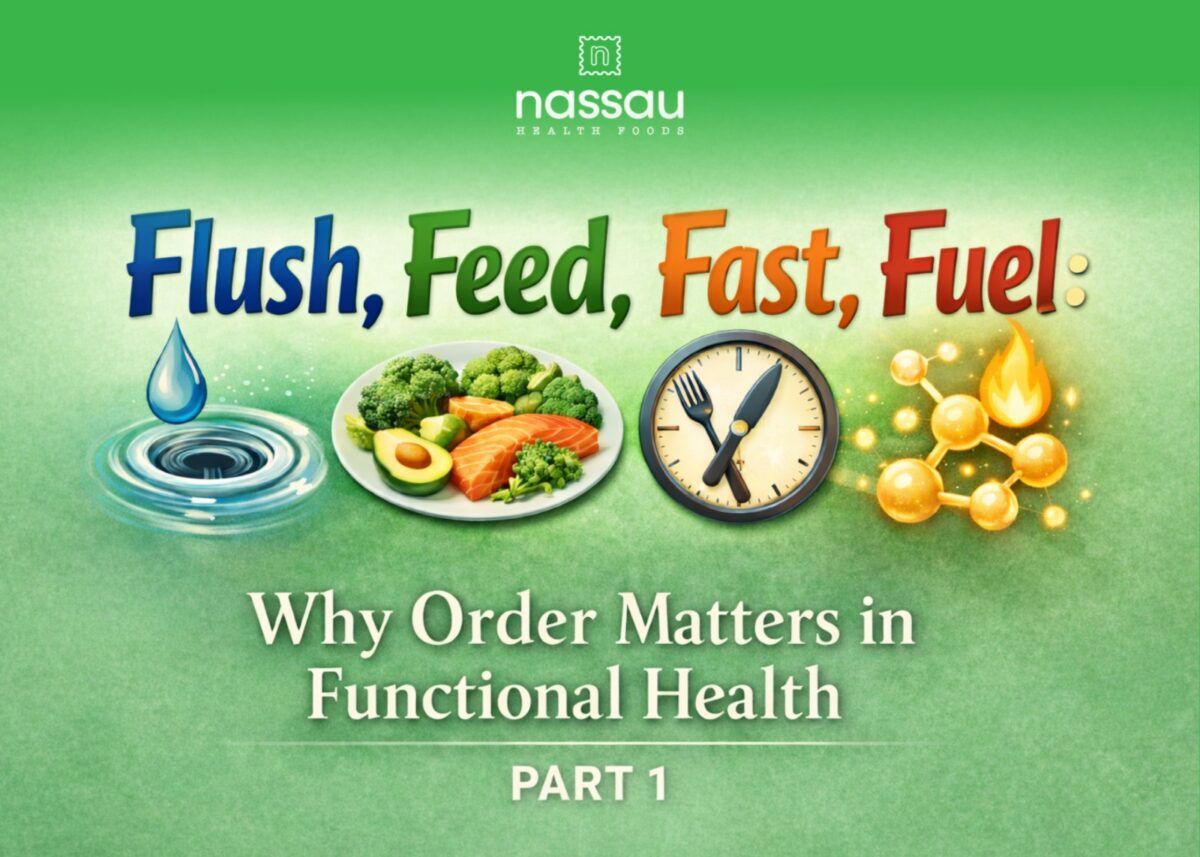
EP 66: Flush, Feed, Fast, Fuel: Why Order Matters in Functional Health (Part 1)
The body is a complex system, and order matters.”

Vince Pitstick

One of the most frustrating experiences in health is doing “all the right things” and still not seeing results.

You clean up your diet.
You try supplements.
You work on stress.
You focus on gut health.

And yet—progress stalls.

In this episode of the Nassau Health Food Store Organic Living Podcast, Steve Adams sits down with functional health expert Vince Pitstick to explore why this happens so often. The issue, they explain, is rarely effort or intention.

More often, it’s order.This conversation introduces Part 1 of the Flush, Feed, Fast, Fuel process, also known as the Four F system—a structured approach to functional health that prioritizes sequence over scattered protocols.


The Body Is a Complex System—Not a Collection of Symptoms

One of the central themes of this episode is that the human body operates as a complex, interconnected system.

When health is approached in isolated pieces—sleep here, gut there, supplements somewhere else—people become overwhelmed. And overwhelmed people tend to quit.

As Steve reflects on his own health journey, he notes how easy it is to forget what it feels like to be a beginner. There are simply too many variables at play:

  • Sleep
  • Stress
  • Nutrition
  • Fasting
  • Movement
  • Emotional health

Without guidance, most people struggle to know where to start—and how to keep going.

Vince emphasizes that coaching is what makes functional medicine truly functional. Having someone walk with you week by week, helping you adjust and adapt, leads to dramatically different outcomes than occasional practitioner visits spaced months apart.


Mental and Emotional Health Often Comes First—Not Last

A powerful insight from this episode is the reminder that many health issues begin mentally and emotionally.

Vince shares from his own experience growing up on a farm and being exposed to environmental and emotional stressors early in life. At the time, his symptoms were labeled as behavioral or psychological, without understanding the deeper physical drivers underneath.

He cautions against assuming that anxiety, intrusive thoughts, or mood challenges are always the root problem.

Often, they are signals.

According to Vince, the nervous system communicates distress through the mind first. When the body has been under chronic stress—chemical, emotional, or metabolic—those signals appear as anxiety, fear patterns, or mood shifts.

This matters because when stress and anxiety become chronic, they activate the sympathetic nervous system. Over time, that constant activation contributes to disease processes throughout the body.


Introducing the Four F Process

The Four F system provides a methodical sequence for addressing health challenges without chasing symptoms.

The four phases are:

  1. Flush
  2. Feed
  3. Fast
  4. Fuel

This episode focuses primarily on why the process begins with Flush and why skipping or rearranging steps often leads to poor results—even when the tools themselves are good.

Vince stresses that the success of this approach is not just about knowledge or protocols, but about organization.


Phase One: Flush — Resetting the System

The first phase, Flush, is about preparing the body to heal.

Rather than starting aggressively with gut protocols or supplements, this phase focuses on:

  • Calming the nervous system
  • Opening lymphatic pathways
  • Supporting liver and gallbladder function
  • Lightly clearing the gastrointestinal tract
  • Stimulating the endocrine system

The goal is to remove friction points so the body can do what it was designed to do.

Vince explains that when these systems are supported early on, a significant portion of anxiety often resolves within weeks. As healing continues, more symptoms fade—leaving behind only what may truly need deeper emotional or genetic work.


Why Starting With the Gut Isn’t Always Step One

Many people begin their health journey by focusing immediately on gut health. Vince acknowledges that this can be effective, but explains why his methodology takes a different approach.

Before going “heavy” on the gut, the Four F process emphasizes:

  • Opening lymphatic flow
  • Calming immune activation
  • Reducing nervous system stress

When gut work does begin in Phase Two, it’s approached with the understanding that the gut is not just about digestion—it’s about the immune system.

Vince notes that approximately 80% of the immune system resides in the gut, which means gut health impacts every system in the body. Shoulder pain, anxiety, infertility, and other seemingly unrelated issues can all be influenced through immune and gut pathways.


Metabolism: The Foundation of Health

A central claim in this episode is that all disease is metabolic.

Vince defines metabolism broadly—not just as calorie burning, but as the body’s ability to:

  • Produce energy
  • Break down substances
  • Process emotions
  • Clear toxins
  • Regulate hormones
  • Manage glucose

When metabolism slows or encounters resistance, things begin to accumulate. Over time, this buildup shows up as elevated blood sugar, inflammation, toxin retention, or hormonal imbalance.The goal of the Four F process is to increase metabolic speed and efficiency, allowing the body to process inputs smoothly rather than storing or reacting to them.


Endocrine Function and Cellular Communication

As part of restoring metabolic flow, the process supports the endocrine system, including:

  • Thyroid
  • Adrenals
  • Ovaries or testes

Vince explains that every cell in the body interacts with thyroid hormone signaling. When these signals improve, cells begin to function more efficiently.

This phase involves:

  • Supporting adrenal and thyroid function
  • Encouraging cellular movement and energy flow
  • Continuing lymphatic and liver support

The intention is not force—but alignment.


From Gut to Blood to Cell

The episode walks listeners through a simple but powerful sequence:

  • Food enters the gut
  • Nutrients move into the bloodstream
  • Nutrients must enter the cell

Once nutrients reach the bloodstream, the focus shifts to:

  • Insulin sensitivity
  • Blood sugar regulation
  • Hormonal signaling (including leptin and ghrelin)
  • Cellular inflammation

This is where fasting strategies begin to play a role—supporting metabolic flexibility, clearing damaged cells, and improving mitochondrial function.


Why Sequence Beats “Perfect Protocols”

To illustrate the importance of order, Vince uses the analogy of a lawn.

You can buy the best seed in the world—but without irrigation, proper timing, and consistent care, the lawn won’t thrive.

The same is true for health.

You can have the right supplements, the right diet, and the right activity—but without proper sequencing, the body never reaches stability.

The Four F process offers a repeatable structure that works even before lab testing is introduced. Vince shares that thousands of people have gone through this process with high success rates using lifestyle changes alone.


A Simpler, More Sustainable Path Forward

This episode does not promote quick fixes or miracle solutions. Instead, it emphasizes:

  • Structure over overwhelm
  • Process over perfection
  • Guidance over guesswork

By approaching the body as an organized system—and respecting the order in which it heals—people experience more consistent, lasting outcomes.


Watch the Full Episode

This blog covers Part 1 of a deeper conversation on Flush, Feed, Fast, Fuel. To hear the full discussion, context, and nuance:

👉 Watch the full episode here: https://youtu.be/YhNcfSHGLLU

🌿 Nassau Health Foods is your local organic and wellness partner.
Shop online anytime: https://nassauhealthfood.com/
Or visit us at 833 T.J. Courson Rd., Fernandina Beach, FL 32034

Transcript Evidence
The following concepts and statements are drawn directly from the episode transcript:
Coaching improves outcomes through consistent guidance (00:03–00:04)
Mental and emotional stress often precedes physical disease (00:05–00:06)
Chronic stress activates the sympathetic nervous system and contributes to disease (00:07)
Phase One focuses on flushing, nervous system calming, lymphatic and endocrine support (00:07–00:08)
Gut health is tied to immune function throughout the body (00:08–00:09)
Health is fundamentally metabolic in nature (00:11)
Endocrine signaling influences every cell (00:12)
Order and organization determine outcomes more than isolated protocols (00:09–00:10)

EP 65: Reduce Toxic Exposure: What Water, Skin, and Everyday Products Are Doing to Your Body, Series 2, Part 2

Before doing anything fancy, you need to reduce exposure.”

Dr. Daniel Kessler

When people think about toxins, they often think about food. But as discussed in this episode, toxic exposure comes from many everyday sources, often in ways people don’t immediately recognize.

The conversation centers on one core idea: before doing anything fancy, the first step is reducing exposure. That means identifying where toxins are coming from and minimizing them where possible. This foundational step matters because the body already has systems designed to filter and eliminate toxins—but those systems can become overwhelmed over time.


Water Quality: A Daily Source of Hidden Exposure

One of the first areas discussed is water quality.

Even when municipal water meets safety standards, it may still contain pharmaceutical remnants and other substances. These remnants can remain present despite treatment processes, and not all water filters remove everything completely.

Listeners are encouraged to become more aware of their own water quality by looking it up by zip code using publicly available resources. The takeaway is not fear—but awareness. Understanding what’s in the water you drink every day is a foundational step in reducing overall exposure.

Key points from the discussion:

  • Municipal water can meet standards yet still contain unwanted substances
  • Pharmaceutical remnants may be present
  • Not all filters remove everything
  • Awareness starts with knowing your local water quality

Small choices, such as choosing higher-quality water options and reducing plastic exposure, are described as practical steps people can take.


Produce: Why Cleaning Matters—Even With Organic Foods

Food quality is another important topic, particularly produce.

While organic options are discussed positively, the episode emphasizes that all produce should be cleaned intentionally. Even organic fruits and vegetables benefit from thorough rinsing.

For non-organic produce, the conversation highlights that some items may be treated with chemicals to enhance color and shelf life. Apples are specifically mentioned as an example where treatments may be used to improve appearance.

The key takeaway is simple: rinsing produce matters. What comes off when fruits and vegetables are washed can be surprising—and reinforces the importance of intentional cleaning practices.


The Skin: The Body’s Largest Organ

A major focus of the episode is skin absorption.

The skin is described as the largest organ in the body, and it absorbs a meaningful percentage of whatever is applied to it. This makes personal care products a significant source of exposure that many people overlook.

Personal Care Products and Hormone Disruption

Certain ingredients commonly found in personal care products are discussed, including:

  • Fragrances
  • Parabens
  • Phthalates

These are described as hormone disruptors, meaning they can interfere with hormonal balance and may mimic estrogen in the body.

The discussion stresses that this isn’t about perfection—it’s about awareness. Many people apply products daily without considering how much the skin absorbs over time.


A Real Patient Story: Reducing Exposure Made a Measurable Difference

One of the most compelling moments in the episode is a real patient story.

A 28-year-old woman, described as healthy and mindful of her diet, showed extremely high autoimmune markers in blood work—levels that should have been zero but were over a thousand.

After reviewing her lifestyle, attention was directed to her personal care products, including:

  • Tanning lotions
  • Makeup applied to the skin and neck
  • Foundation products

The recommendation focused on switching these products.

What Happened Next

After three months:

  • Autoimmune markers dropped from over 1,000 to under 300
  • This change occurred without adding new interventions, simply by reducing exposure

This story illustrates how everyday products can contribute to toxic load—and how reducing exposure can lead to measurable changes.


How the Body Filters Toxins

The episode explains that the body already has natural filters, including:

  • The liver
  • The kidneys
  • The skin

Over time, these filters can become burdened. Many toxins are described as fat-soluble, meaning they can remain stored unless the body is supported in eliminating them.

How Toxins Leave the Body

According to the discussion, toxins can be eliminated through:

  • Urination
  • Bowel movements
  • Sweating
  • Breathing

As toxins are released, people may notice:

  • Stronger body odor
  • Changes in breath
  • Increased sweating

Rather than seeing these as negative signs, they are framed as indicators that the body is actively eliminating stored substances.


Detox Symptoms: Why Discomfort Can Be Normal

A personal experience is shared involving switching to non-toxic deodorant.

During the first 60 days:

  • Body odor increased
  • The body appeared to be adjusting

After this period:

  • Odor normalized
  • Less product was needed overall

This example reinforces the idea that temporary discomfort doesn’t mean something is wrong. In many cases, it can reflect the body adapting as exposure is reduced.


The Rowing Team Analogy: A Practical Way to Think About Detox

Toward the end of the episode, a powerful analogy is introduced by a board-certified toxicologist.

Each rower in a rowing team represents something a person can do to reduce toxic load and support the body’s filtering systems.

The First Rower: Reduce Exposure

Before:

  • Supplements
  • Saunas
  • Exercise routines

The first and most important rower is reducing exposure.

This means:

  • Evaluating water quality
  • Reviewing kitchen and cleaning products
  • Assessing personal care items
  • Asking whether daily choices are helping or harming

Only after reducing incoming exposure does it make sense to focus on supporting detox pathways.


Small Changes, Consistent Progress

The episode emphasizes progress over perfection.

Rather than trying to change everything at once, listeners are encouraged to:

  • Make one small improvement
  • Aim to improve by 1% each day

Over time, these small changes compound, leading to meaningful reductions in toxic load.


A Broader View of Health

The conversation expands on a familiar phrase: “We are what we eat.”
It’s reframed as:

  • We are what we eat
  • We are what we digest
  • We are what we absorb
  • We are what we excrete

This broader view highlights why exposure—from water, air, and skin contact—matters just as much as diet.


Where to Start If You Feel Overwhelmed

A recurring theme is that people often don’t know where to begin.

A simple starting point suggested in the discussion:

  • Ask yourself how you feel
  • Identify one area where exposure could be reduced
  • Make one change

This grounded approach removes overwhelm and keeps the focus on practical, sustainable steps.


Final Thought: Commit to Your Body Daily

Rather than treating health as a short-term resolution, the episode encourages a daily commitment.

Reducing toxic exposure isn’t about extremes—it’s about awareness, intention, and consistency. Over time, these choices support the body’s natural ability to filter and eliminate what it no longer needs.

Read: “Toxin Burden and Your Health: Why What You’re Exposed to Matters More Than You Think, Series 1”

Read: “How Toxins Quietly Shorten Your Health Span, Series 2, Part 1”

👉 Watch the full episode here: https://youtu.be/9UnuCQjnJ5Y
👉 Shop online anytime at https://nassauhealthfood.com/
📍 Or visit us at 833 T.J. Courson Rd., Fernandina Beach, FL 32034

All information, examples, analogies, and conclusions in this article are derived exclusively from the podcast transcript, including discussions on water quality, produce cleaning, skin absorption, hormone disruptors, patient experience, detox symptoms, and the rowing team analogy.
No external studies, statistics, or claims were added.

EP 64: How Toxins Quietly Shorten Your Health Span

Everyone carries some level of toxins—
regardless of age.”

Dr. Daniel Kessler

Most people associate toxins with something obvious—an illness, a reaction, or an emergency. But according to Dr. Daniel Kessler, that assumption is exactly what causes many people to miss the bigger picture.

In this episode of the Organic Living Secrets podcast, Steve Adams sits down with Dr. Kessler to explore how toxins can quietly shorten your health span—the years you live in good health—even when blood work appears normal and symptoms are minimal.

This is not a fear-based discussion. It is a grounded, practical conversation about awareness, everyday exposure, and the small choices that can meaningfully influence long-term health.


What Is Health Span—and Why It’s Different From Life Span

Life span refers to how long you live.
Health span refers to how long you live well.

Dr. Kessler explains that many people feel reassured when routine labs come back normal. But that reassurance can be misleading. A person may technically be “alive and functioning” while slowly accumulating internal stressors that reduce vitality over time.

The problem, he notes, is that people often wait for something bad to happen before they start asking deeper questions:

  • Why didn’t I know sooner?
  • Could this have been prevented?
  • Was there something I could have done differently?

This gap—between feeling okay and actually being healthy—is where health span quietly erodes.


Dr. Kessler’s Background in Environmental Health

Before becoming a practicing physician, Dr. Kessler worked at the Centers for Disease Control, specifically at the National Center for Environmental Health.

His role involved analyzing blood and serum samples from people across:

  • All age groups, from infants to the elderly
  • Populations across the United States
  • Samples from around the world

What he found was consistent and striking:

Every individual—regardless of age—had some level of toxins present in their body.

This exposure was not limited to people who were sick. It was universal.


Why Toxins Are Often a “Hidden Load”

Dr. Kessler refers to toxin accumulation as a hidden load—something the body adapts to over time without producing immediate symptoms.

The human body is resilient. It can compensate for stressors for years. But that adaptation comes at a cost.

Many patients, he explains, experience symptoms such as:

  • Not feeling well
  • Low energy
  • Ongoing discomfort without clear diagnosis

Yet standard blood work often appears mostly normal.

That disconnect is what leads to frustration—for both patients and doctors.


Acute Care vs. Chronic Exposure

Modern healthcare excels at acute intervention.

If someone has:

  • A heart attack
  • A severe infection
  • A sudden medical emergency

The system responds quickly and effectively.

However, Dr. Kessler points out that chronic, low-level exposure to toxins does not trigger alarms. These exposures:

  • Do not cause immediate harm
  • Build slowly over years or decades
  • Often go unaddressed

This is why many people feel something is “off” without being able to pinpoint why.


Types of Toxins Discussed in the Episode

Dr. Kessler explains that the word toxin can be misleading and overly broad. He breaks it down into categories discussed in the conversation:

1. Infectious Toxins

These are produced during infections such as:

  • Flu
  • Viral illnesses
  • Food poisoning

They often cause noticeable symptoms and resolve once the infection clears.

2. Man-Made and Environmental Exposures

These include synthetic chemicals that:

  • Did not exist a century ago
  • Are encountered daily
  • Accumulate slowly

Dr. Kessler notes that the body may encounter thousands of these chemicals over time.

Most exposures do not cause immediate illness—but chronic exposure can quietly contribute to:

  • Inflammation
  • Hormone disruption
  • Reduced health span

Why Feeling “Fine” Can Be Misleading

One of the most important ideas in the episode is this:

Feeling okay does not always mean you are as healthy as you think.

Dr. Kessler emphasizes that many people delay action because nothing feels urgent. They wait for pain, diagnosis, or crisis before making changes.

By the time something shows up clearly, the underlying issues may have been developing for years.


The Kitchen as a Major Exposure Zone

When discussing practical changes, Dr. Kessler starts where people spend a large portion of their time: the kitchen.

Food as a Major Influence

Food matters—not just nutritionally, but chemically.

Dr. Kessler describes food as one of the most impactful daily exposures and notes that sugar is widely recognized as a major contributor to health issues.

He also references recent changes to the food pyramid, emphasizing shifts toward:

  • Less grains
  • More healthy fats
  • More healthy proteins

(Specific details beyond this were not expanded further in the transcript.)


Cookware and Chemical Exposure

Cookware is another overlooked source of exposure.

Dr. Kessler discusses concerns around:

  • Non-stick cookware
  • Overheating or scratching surfaces
  • Release of certain chemicals when damaged

He mentions PFAS—often referred to as “forever chemicals”—and explains that these substances can accumulate in the body over time.

Practical Alternatives Mentioned

  • Switching to stainless steel cookware
  • Being mindful of utensil materials

Plastics and Heat: A Risk Combination

Plastic exposure is discussed in the context of heat.

Dr. Kessler highlights a key principle:

Heat accelerates chemical migration from plastic into food.

He strongly advises against:

  • Microwaving food in plastic containers
  • Trusting “microwave-safe” labels

Preferred Options Mentioned

  • Glass containers
  • Ceramic containers

When storing leftovers, transferring food into these materials can reduce exposure.


Why This Is Not a Fear-Based Conversation

Throughout the episode, Dr. Kessler repeatedly emphasizes control—not fear.

The goal is not to eliminate all exposure (which is unrealistic), but to:

  • Reduce unnecessary exposure
  • Make better daily choices
  • Focus on small, consistent improvements

He stresses that people are far more empowered than they realize.


Small Changes Add Up Over Time

The central message of the episode is simple:

Small, practical changes—applied consistently—can meaningfully reduce toxic load over time.

These changes do not require extreme measures, perfection, or panic. They require awareness and intention.n’t toxin-free and explains that Nassau Health Foods exists to help people make those choices more easily.


Protecting Your Health Span

Health span is not something that suddenly disappears. It is gradually shaped by daily decisions, environmental exposures, and long-term habits.

This conversation invites listeners to stop waiting for symptoms and start thinking earlier—before problems become obvious.

Read Series 1 herehttps://nassauhealthfood.com/ep63-toxin-burden-and-your-health-why-what-youre-exposed-to-matters-more-than-you-think/ 

Read Series 2, Part 2 here: https://nassauhealthfood.com/ep65-reduce-toxic-exposure-what-water-skin-and-everyday-products-are-doing-to-your-body-series2-part2/

👉 Watch the full episode here: https://youtu.be/xUbDOeMWcS8
👉 Shop online anytime at https://nassauhealthfood.com/
📍 Or visit us at 833 T.J. Courson Rd., Fernandina Beach, FL 32034

All claims, examples, explanations, and recommendations in this article were derived exclusively from the recorded conversation between Steve Adams and Dr. Daniel Kessler on the Organic Living Secrets podcast episode discussing toxins and health span. No external sources, studies, statistics, or interpretations were added beyond what was stated in the transcript.

EP 62: Healthspan > Lifespan: Why the Quality of Your Years Matters More Than How Long You Live

“Food is medicine—or it’s poison.

Nassau Health Foods

Welcome to the Organic Living Secrets Podcast

Hi, I’m Steve Adams—owner of Nassau Health Foods on Amelia Island, Florida—and welcome to the Organic Living Secrets podcast.

If you live on Amelia Island or anywhere in Nassau County (Northeast Florida near the Georgia border), I want you to think of this podcast as yours. It’s built around the people and the pace of life here—morning beach walks, downtown Fernandina charm, community events, and the kind of everyday moments you want to enjoy for as long as possible.

And that brings us to the point of this show.


My Story: Why I Care So Much About “Healthspan”

Before I owned a health food store, I spent years as a corporate banker and then 21 years helping grow a chain of nearly 50 pet stores. In 2017, I exited that business—largely because my health had declined and I wanted to be proactive about changing the trajectory of my life.

I come from a family with shorter lifespans and poor health outcomes. I didn’t want that story to repeat—for me, and for my children and grandchildren.

That’s when I worked with a naturopathic MD and went through a functional medicine approach: reverse-engineering health from a root-cause perspective. Over time, it helped me rebuild my health to the point that, in my early 60s, I genuinely feel better than I did in my 40s.


Healthspan vs Lifespan: The 11-Year Wake-Up Call

In the intro episode, I share a simple concept that changes how you think about aging:

  • Lifespan = how long you live
  • Healthspan = how many of those years you live healthy, active, and fully able to enjoy life

In the episode, I reference a commonly used example: an average lifespan of about 77 years and an average healthspan of about 66 years—meaning the last ~11 years can be compromised by chronic health challenges.

Whether your personal “gap” is 11 years or more, the takeaway is the same:

We want to compress that gap.
Not just live longer—live better for longer.


Why Nassau Health Foods Calls You a “Client,” Not a “Customer”

At Nassau Health Foods, we don’t think of our relationship with you as transactional.

A “customer” buys a product.
A “client” is someone we guide, with your best interest at heart.

That’s why we invest in knowledgeable people, curated product selection, and an environment where you can actually ask questions and get support.


Clean Living Starts at the Cellular Level

One of the ideas I’ve learned through Tiger Medical Institute is that cellular health has key drivers. When your cells are supported, your tissues are supported, your organs are supported—and your whole body benefits.

In the episode, I mention three foundational pillars:

  • Lower oxidative stress
  • Lower inflammation
  • A healthier internal environment for your cells to thrive

That’s why clean food and clean household/wellness products matter—not as “trends,” but because they reduce long-term burden on the body.

Or said another way:

Food is medicine… or it’s poison.


“Clean Costs More”… But Getting Sick Costs More

Yes, clean living can cost more upfront. Quality ingredients, better sourcing, and a staffed store that can actually help you—those aren’t free.

But the tradeoff is real:

It costs more to get sick.

And if you’re over 50, the biggest risk for most people isn’t a financial crisis—it’s a sudden health decline that changes everything.


Here’s the Point: No One Will Do This For You

Insurance will keep you alive. It won’t build your healthspan.

Medicare won’t become your health coach.
Blue Cross won’t plan your meals.
United won’t teach you how to lower your toxin load.

This depends on you.

And here’s the encouraging part: if you’ve built a life that allows you to live in a place like Amelia Island, you’ve already done hard things. You can do this too.


What’s Coming on the Podcast

I’m excited about the future of this show—because going forward, Dr. Daniel Kessler will join me weekly. He’s a functional medicine physician, Mayo-trained, and trained in the Swiss Biologic Method, which focuses on detox and creating a healthier cellular environment.

Together, we’ll unpack topics you can learn and apply—whether or not we sell the solution in our store. Because the real goal is simple:

Nassau Health Foods should be a resource center for community health.


Subscribe and Join Us

If you want to protect your healthspan—and keep enjoying the beach walks, downtown events, travel, time with grandkids, and the life you’ve built—subscribe to the Organic Living Secrets podcast.

And if you’re local, come visit us at Nassau Health Foods. We’re grateful for your support and excited for what’s coming in 2026.

Subscribe now—and let’s live better, longer.

Subscribe here: https://podcasts.apple.com/us/podcast/organic-living-secrets-amelia-island-by-nassau-health/id1773754456


Nassau Health Foods
Locally trusted since 1985.

Shop all things organic herehttps://nassauhealthfood.com/ 

EP 24: The Hidden Energy Crisis Inside Your Body: How to Reclaim Your Vitality with Every Meal

“Your body is like a car—it needs the right fuel, regular maintenance, and a clean environment to run smoothly. If you’re always tired, something’s out of balance, but the good news is: you CAN fix it!”

Does this sound familiar? You wake up tired, even after 8 hours of sleep. By mid-afternoon, you’re reaching for another cup of coffee or a sugary snack to keep going. And by the end of the day, you’re completely drained, with no energy left for the things you love.

If you’re nodding along, you’re not alone. Many people feel like they’re running on empty, but they don’t know why. The truth is, your energy crisis isn’t just in your head—it’s happening inside your body. And today, we’re going to show you how to fix it.

Let’s break this down step by step, so you can understand why your energy is low and how to take it back.


Why You’re Always Tired

Imagine your body as a beautiful, high-performance car. It’s designed to run smoothly and efficiently, but only if you give it the right care. If you’re feeding it the wrong fuel, skipping maintenance, or letting it sit in a polluted environment, it will start to break down.

Here are the top 3 reasons why your energy might be running low:

1. Toxins Are Weighing You Down

Think of toxins like mud being thrown at your car’s engine. Over time, they clog up the system, making it harder for your body to function.

Every day, we’re exposed to toxins from:

  • Pesticides on non-organic fruits and vegetables.
  • Harsh chemicals in household cleaners.
  • Artificial fragrances in personal care products.

These toxins overload your liver, disrupt your hormones, and create inflammation—all of which leave you feeling tired and sluggish.


2. Your Blood Sugar Is on a Rollercoaster

Have you ever eaten a big bowl of pasta or a sugary snack, only to feel hungry and tired an hour later? That’s your blood sugar playing tricks on you.

When you eat processed carbs and sugary foods, your body burns through the energy quickly, causing a crash. This cycle leaves you feeling tired, cranky, and craving more sugar.


3. You’re Missing Key Nutrients

Just like a car needs oil and gas to run, your body needs certain nutrients to produce energy. Without enough magnesium, B vitamins, and healthy fats, your cells can’t do their job properly.

If you’re eating a diet full of processed foods, you’re likely missing these essential nutrients, which can leave you feeling drained.


How to Fix Your Energy Crisis

The good news? You can reclaim your energy by making a few simple changes to your diet, environment, and lifestyle. Let’s look at the three pillars of energy:


Pillar 1: Reduce Toxins

Imagine trying to drive your car with mud clogging up the engine. That’s what toxins do to your body—they slow everything down. Here’s how to clean up your system:

1. Choose Organic Produce

Start with the Dirty Dozen—fruits and vegetables that are most heavily sprayed with pesticides, like strawberries, spinach, and apples. By swapping these for organic options, you reduce your toxin exposure and help your body work more efficiently.

2. Switch to Natural Cleaners

Harsh chemical cleaners can harm your lungs and skin, and they add unnecessary toxins to your home. Use natural options like vinegar, baking soda, or plant-based cleaners to keep your space safe.

3. Go Fragrance-Free

Many personal care products contain artificial fragrances, which are loaded with chemicals that disrupt your hormones. Look for fragrance-free or naturally scented options to give your body a break.


Pillar 2: Eat for Energy

Your body is like a car—it runs best on high-quality fuel. If you’re feeding it processed carbs and sugary snacks, you’re running on fumes. Instead, focus on foods that give you steady, long-lasting energy.

1. Add Healthy Fats

Healthy fats like avocado, olive oil, nuts, and seeds are like premium gas for your body. They provide long-lasting energy and help stabilize your blood sugar.

2. Focus on Clean Proteins

Grass-fed meats, wild-caught fish, and plant-based proteins like lentils and chickpeas are packed with nutrients that support energy production.

3. Load Up on Veggies

Non-starchy vegetables like spinach, broccoli, and zucchini are full of fiber, vitamins, and minerals that keep your body running smoothly.

Pro Tip: If you’re not sure where to start, visit Amelia Fresh Café! We serve low-carb, nutrient-dense meals that are fresh, delicious, and designed to fuel your body.


Pillar 3: Build Energy-Boosting Habits

Your lifestyle plays a huge role in how much energy you have. By making a few small changes, you can feel more energized every day.

1. Get Better Sleep

Your body needs time to recharge. Aim for 7-9 hours of sleep each night, and try turning off screens an hour before bed to help your brain wind down.

2. Move Your Body

Exercise doesn’t have to be intense to be effective. A 10-minute walk outside can boost your energy by improving blood flow and oxygenation.

3. Stay Hydrated

Dehydration is a common energy zapper. Drink plenty of filtered water throughout the day to keep your body functioning at its best.


A Real-Life Success Story

Let me tell you about Sarah, a mom on Amelia Island who felt like she was running on empty. Between work, kids, and everyday stress, she had no energy left for herself.

After visiting Nassau Health Foods, Sarah made three simple changes:

  1. She switched to organic produce from the Dirty Dozen list.
  2. She started adding healthy fats like avocado and olive oil to her meals.
  3. She replaced her chemical cleaners with natural alternatives.

Within a few weeks, Sarah noticed a huge difference. She had more energy, fewer headaches, and even clearer skin!

Her advice? “Start small. Just one change can make a big difference in how you feel.”


Your Action Plan: 3 Steps to Get Started

Now it’s your turn! Here are 3 quick, actionable steps you can take today:

1️⃣ Swap one high-pesticide fruit or veggie for an organic option. Start with strawberries or apples.
2️⃣ Try a nutrient-dense, low-carb meal at Amelia Fresh Café. It’s a delicious way to fuel your body.
3️⃣ Replace one toxic product in your home with a natural alternative. Start small—every step counts!

Final Thoughts

Your energy is one of your most valuable resources. When you take care of your body—by reducing toxins, eating better, and building healthy habits—you’ll feel the difference in every part of your life.

At Nassau Health Foods, we’re here to help you every step of the way. Whether you need advice on clean products, a fresh meal from Amelia Fresh Café, or personalized health insights through our Thrive Membership Plans, we’ve got you covered.

💬 What’s one small change you’ll make today to boost your energy? Share in the comments—we’d love to hear from you!

🌱 Visit us in-store or online to start your journey toward better energy and vibrant health. https://nassauhealthfood.com

EP 23: Toxins, Ketones & Organic Living: A Wellness Guide for Amelia Island Locals

“The food you eat can be either the safest and most powerful form of medicine or the slowest form of poison.”– Ann Wigmore

Meet Sarah. She’s a 45-year-old mother of two who moved to Amelia Island last year seeking a healthier lifestyle for her family. Like many of us, Sarah was overwhelmed by conflicting health information. Should she go keto? Is organic really worth the extra cost? What about all those chemicals in her cleaning products?

Sarah’s journey began when her friend invited her to a workshop at Nassau Health Foods. That day changed everything. She learned that small, consistent choices could make a big difference in her family’s health—especially when it came to toxins, nutrition, and organic living.

Today, we’re sharing what Sarah discovered, inspired by Dr. Natasha Winters’ groundbreaking book, “The Metabolic Approach to Cancer.” Don’t worry—this isn’t just for people dealing with serious health concerns. These principles can help everyone live healthier, more vibrant lives right here on Amelia Island.

What is the Metabolic Approach?

Think of your body as a garden. For plants to thrive, they need good soil, clean water, and protection from harmful chemicals. Your body works the same way!

Dr. Nasha Winters discovered through her own cancer journey that our metabolism—how our bodies turn food into energy—plays a huge role in our health. Her approach focuses on:

  • Eating foods that nourish us deeply
  • Reducing sugar and using ketones for energy
  • Avoiding toxins that harm our cells
  • Supporting our body’s natural cleaning systems

The best part? You don’t need a major health scare to benefit from these ideas. Every single person on Amelia Island can use these principles to feel better today and protect their health for tomorrow.

Toxins: The Hidden Troublemakers

Toxins are like uninvited guests that sneak into your home and cause trouble. They come from:

  • Pesticides on fruits and vegetables
  • Chemicals in cleaning products
  • Ingredients in personal care items like shampoo and lotion
  • Plastics in food packaging
  • Pollution in the air and water

These toxins don’t just sit on the surface—they get into our bodies and can disrupt our hormones, burden our liver, and create inflammation. Over time, this can lead to feeling tired, gaining weight, having skin problems, or even developing serious health conditions.

How to Reduce Your Toxic Load

Good news! You have more control than you might think. Here are simple ways to start:

  1. Choose organic produce when possible – Especially for the “Dirty Dozen” (strawberries, spinach, kale, apples, grapes, peaches, cherries, pears, tomatoes, celery, potatoes, and bell peppers), which have the most pesticide residue.
  2. Switch to natural cleaning products – Many conventional cleaners contain harsh chemicals that can irritate your lungs and skin. Natural alternatives clean just as well without the health risks.
  3. Read labels on personal care products – Look for items without parabens, phthalates, artificial fragrances, and other harmful ingredients.
  4. Drink filtered water – This helps remove chemicals that might be in your tap water.
  5. Use glass or stainless steel containers – These are better than plastic for storing food and drinks.

At Nassau Health Foods, we’ve carefully selected products that meet strict standards for safety and purity. Our team can help you find alternatives to any toxic products currently in your home.

Ketones: Your Body’s Clean-Burning Fuel

Imagine your body as a car that can run on two different fuels: sugar or ketones. Most Americans run mainly on sugar (from carbs), which is like using low-quality gas that makes your engine run rough and creates a lot of smoke.

Ketones, on the other hand, are like premium, clean-burning fuel. When your body makes ketones (which happens when you eat fewer carbs and more healthy fats), many people experience:

  • More stable energy throughout the day
  • Clearer thinking
  • Less hunger and fewer cravings
  • Reduced inflammation
  • Better mood

Dr. Winters explains that cancer cells prefer sugar as fuel, while healthy cells can thrive on either sugar or ketones. By shifting toward more healthy fats and fewer processed carbs, you give your healthy cells an advantage.

How to Introduce More Ketone-Friendly Eating

You don’t have to go fully “keto” to benefit from this concept. Start with these simple steps:

  1. Reduce processed carbs – Cut back on bread, pasta, cookies, and sugary drinks.
  2. Add healthy fats – Incorporate avocados, olive oil, nuts, seeds, and coconut oil into your meals.
  3. Focus on fiber-rich vegetables – Fill half your plate with non-starchy vegetables like leafy greens, broccoli, cauliflower, and zucchini.
  4. Choose quality protein – Opt for grass-fed meat, wild-caught fish, free-range eggs, or plant-based options like tempeh and lentils.

At our Amelia Fresh Café, we serve delicious meals that align with these principles—low in sugar, rich in nutrients, and made with clean ingredients. It’s an easy way to try this style of eating without having to cook!

Organic Living: A Whole-Life Approach

Organic living goes beyond just food. It’s a mindset of choosing what nourishes us and avoiding what depletes us.

Think of it like building a house. You wouldn’t use cheap, toxic materials that could make your family sick, right? The same principle applies to what you put in and on your body, and what you bring into your home.

The Benefits of Organic Living

  1. Fewer toxins enter your body – Organic foods have significantly lower pesticide residues than conventional options.
  2. Better nutrition – Studies show that organic produce often contains more beneficial nutrients and antioxidants.
  3. Protection for children – Kids are especially vulnerable to pesticides and chemicals because their bodies are still developing.
  4. Environmental health – Organic farming practices protect soil, water, birds, bees, and other wildlife.
  5. Support for local farms – When you buy organic, especially from local sources, you help sustain farms that care for the land.

Organic Living on Amelia Island

We’re lucky to live in a place where fresh, local options are available year-round. At Nassau Health Foods, we’ve been connecting island residents with clean, organic products since 1985.

When you walk into our store, you’ll find:

  • Certified organic produce
  • Clean, third-party tested supplements
  • Natural personal care products
  • Eco-friendly household items
  • Knowledgeable staff who can answer your questions

We believe that every small choice matters—and adds up to big results over time.

Start Your Journey Today: 3 Simple Steps

Taking care of your brain doesn’t have to be hard. Start with one small step today:

  • Add a handful of berries to your breakfast.
  • Take a 10-minute walk during your lunch break.
  • Try going to bed 30 minutes earlier tonight.

Over time, these little changes add up to big benefits for your brain.


Susan’s Story: A Happy Ending

Ready to begin? Here are three easy ways to take action:

1. Make One Food Swap

Choose one item from the Dirty Dozen list and buy the organic version instead. For example, if you eat apples regularly, switch to organic apples. This single change can significantly reduce your pesticide exposure.

2. Try a Clean, Low-Carb Meal

Visit Amelia Fresh Café for a nutrient-dense lunch that follows the principles we’ve discussed. Our seasonal specials incorporate local ingredients whenever possible, and our menu clearly marks items that are gluten-free, dairy-free, and low in sugar.

3. Replace One Household Product

When you run out of a cleaning product or personal care item, replace it with a natural alternative. Our staff can help you find options that work just as well without the harmful ingredients.


Going Deeper: Resources for Your Health Journey

If you’re ready to take your health to the next level, Nassau Health Foods offers:

  • Glycocheck Screenings – A powerful way to assess your cardiovascular and metabolic health
  • Thrive Membership Plans – Personalized guidance and support for your wellness goals
  • Educational Workshops – Free sessions on various health topics throughout the year

Sarah’s Success Story

Remember Sarah from the beginning of our story? Six months after making these changes, she noticed:

  • More energy throughout the day
  • Clearer skin
  • Fewer headaches
  • Better sleep
  • And her seasonal allergies improved significantly

These benefits didn’t happen overnight. They came from consistent, small changes—the kind anyone can make.

Your Health Matters

At Nassau Health Foods, we believe that health is your most valuable asset. We’re committed to providing the products, information, and support you need to make better choices for yourself and your family.

Whether you’re dealing with specific health concerns or simply want to feel your best, the principles of reducing toxins, incorporating healthy fats, and embracing organic living can transform your health from the inside out.

Visit our store, check out our café, or join us for an upcoming workshop. We’re here to support your journey to vibrant health—every step of the way.

Your health matters. And here on Amelia Island, you have a partner dedicated to helping you thrive.

Visit the Nassau Health Store at Amelia Island or order online at https://nassauhealthfood.com

EP 09: Microbiome Masters: Building Better Brain Health Naturally

Imagine standing in your kitchen, holding a fresh, organic apple. As you take a bite, you might think you’re simply satisfying your hunger. But what if I told you that this simple act could be reshaping the very foundation of your mental clarity, mood, and long-term cognitive health?


“Here on Amelia Island, we’re fortunate to have access to fresh organic foods and a lifestyle that supports wellness,” shares Steve Adams, host of the Nassau Health Food Store Podcast. And he’s onto something bigger than most people realize.

“Your gut is like a garden – what you feed it shapes the landscape of your mind. Every organic bite is a seed of clarity, every probiotic a new flower of vitality. The path to your brightest thoughts begins with nurturing the soil of your inner ecosystem. Today, choose to be both the gardener and the garden.”


Steve Adams, Nassau Health Foods

The Hidden Command Center in Your Gut

Think of your gut as Mission Control for your overall health. Just as NASA’s command center coordinates countless complex operations, your gut microbiome orchestrates an intricate dance of trillions of bacteria that influence everything from your brain function to your immune system strength.


But here’s the shocking truth: Modern life is waging a silent war against this delicate ecosystem.


As Dr. David Perlmutter reveals in his groundbreaking book “Brain Maker,” the connection between our gut microbiome and brain health isn’t just important—it’s absolutely crucial. Yet most of us are unknowingly sabotaging this vital relationship every single day.

The Modern Health Crisis Nobody’s Talking About

Consider this: Every time you reach for that processed snack or antibiotic-laden food, you’re potentially disrupting millions of years of evolutionary wisdom encoded in your gut bacteria. The impact? A cascade of effects that can influence:

  • Your daily mood swings
  • Mental clarity and focus
  • Long-term cognitive health
  • Immune system resilience
  • Overall wellness and vitality

“Every day you delay making the switch to organic, you’re potentially exposing yourself and your loved ones to harmful pesticides and GMOs,” warns Adams. It’s a sobering thought, isn’t it?

The Perfect Storm Against Your Health

Modern life has created a perfect storm of factors working against your gut health:

  1. Processed foods flooding our supermarkets
  2. Environmental toxins in our daily environment
  3. Chronic stress becoming the new normal
  4. Overuse of antibiotics
  5. Lack of naturally fermented foods in our diet
  6. Poor sleep quality affecting gut balance

It’s like trying to grow a garden in concrete—possible, but unnecessarily challenging.

Your Roadmap to Better Brain Health


The good news? Nature has provided everything we need to rebuild and maintain a healthy gut-brain connection. Think of it as assembling a powerful team of microscopic allies, each playing a crucial role in your cognitive wellness.

The Foundation: Probiotic Powerhouses

Start with these natural gut-health champions:

  • Organic sauerkraut: A fermented superfood packed with beneficial bacteria
  • Kimchi: Your spicy ally in gut diversity
  • Kombucha: The effervescent elixir of gut health
  • Natural yogurt: A creamy source of beneficial bacteria

The Support System: Prebiotic Fuel

Feed your microscopic allies with:

  • Jerusalem artichokes: Nature’s prebiotic powerhouse
  • Organic garlic: A natural gut health booster
  • Fresh onions: Packed with gut-supporting compounds
  • Organic asparagus: A fiber-rich prebiotic source

The Brain Maker Protocol: Your Step-by-Step Guide

Step 1: Cleanse and Reset

Think of this as clearing the slate for your new gut health journey. Just as you wouldn’t build a new house on a shaky foundation, you need to prepare your gut for optimal health.

Step 2: Feed Your Microbiome

This is where the magic happens. By introducing the right foods and supplements, you’re essentially recruiting and training an army of beneficial bacteria to support your brain health.

Step 3: Maintain and Thrive

This is your long-term strategy for success. It’s about creating sustainable habits that support both your gut and brain health for years to come.

Your Personal Transformation Awaits

Remember the feeling of standing in the grocery aisle, overwhelmed by choices? That stops today. With the right knowledge and support, you can make confident decisions about your health.


The path to better brain health isn’t just about what you eat—it’s about transforming your relationship with food and understanding its profound impact on your cognitive wellness.


“Transform your gut-brain health today,” isn’t just a catchy phrase—it’s an invitation to take control of your cognitive destiny.

Take Action Now

Don’t let another day pass by while your gut-brain connection suffers in silence. Your journey to optimal health begins with a single step.


Visit OptimalHealthAssessment.com today for your free personalized gut health assessment. Discover exactly where you stand and receive a customized protocol designed to optimize your gut-brain connection.

“Your brain’s best days aren’t behind you—they’re just ahead, waiting for you to make the right choices for your gut health.”

For heart-healthy organic products, shop online or visit our local store at Amelia Island!

EP 08: Your Natural Path to Brain Wellness

Picture this: You’re standing in your kitchen, staring at the grocery list in your hand, but something doesn’t feel quite right. That moment when you can’t remember what you came to get – it’s more than just a simple memory slip. It’s a wake-up call that many of us in the Amelia Island community have experienced.

“Your brain isn’t just a computer – it’s a garden. Every healthy choice you make plants a seed, every positive habit waters the soil, and every day you prioritize your cognitive health, your garden grows stronger. Remember, it’s never too late to start cultivating the mind you want to keep for a lifetime.”


Steve Adams, Nassau Health Foods

The Silent Crisis in Cognitive Health

“While our Amelia Island community offers a peaceful retirement paradise, maintaining cognitive health remains a top priority for many residents,” shares Steve Adams, host of the Nassau Health Food Store Podcast. This paradise we call home holds a secret that many aren’t talking about – the growing concern over cognitive decline.


In today’s fast-paced world, our brains are under constant assault. From processed foods to environmental toxins, from chronic stress to poor sleep habits, we’re facing what Dr. Dale Bredesen calls “the 36 holes in your roof” – a powerful metaphor for the multiple factors contributing to cognitive decline.

The True Cost of Inaction

“Every day you delay making the switch to organic, you’re potentially exposing yourself and your loved ones to harmful pesticides and GMOs,” warns Adams. But it’s not just about organic food. The cost of ignoring brain health is far greater than many realize.


Think of your brain like a premium sports car. You wouldn’t put low-grade fuel in a Ferrari, would you? Yet many of us unconsciously do exactly that with our most precious asset – our brain. The longer we collectively hesitate, the more damage accumulates, silently and steadily.

The Revolutionary Approach to Brain Health

Dr. Bredesen’s groundbreaking research presents a paradigm shift in how we approach cognitive health. Instead of accepting cognitive decline as inevitable, we now understand it as a multi-factorial condition that can be prevented and potentially reversed.

Your Heart’s Journey to Wellness


Your journey to optimal brain health begins with what’s on your plate. The protocol emphasizes:

  • Anti-inflammatory foods
  1. Organic vegetables and fruits
  2. Wild-caught fish rich in omega-3s
  3. Brain-nourishing healthy fats
  • Strategic supplementation
  1. Omega-3 fatty acids for brain structure
  2. B-complex vitamins for energy metabolism
  3. Vitamin D3 for neuroprotection
  4. Curcumin for inflammation support
  5. MCT oil for alternative brain fuel

The KetofLEX 123 Approach

This isn’t just another diet – it’s a brain-optimization strategy that works with your body’s natural rhythms:

  • 12-hour fasting window to promote cellular repair
  • 3 hours between dinner and bedtime for optimal sleep
  • Emphasis on healthy fats and quality proteins
  • Strategic incorporation of low-glycemic vegetables

Your Personal Brain Health Revolution


“Have you ever stood in the grocery aisle overwhelmed by choices, wondering which products are truly good for you and the planet?” This common experience reflects a deeper truth – we all want to make better choices, but the path isn’t always clear.

A Comprehensive Approach

Your brain health journey doesn’t have to be overwhelming. Here’s how to take control:

  1. Detoxification Support
    • Organic detox teas
    • Natural cleaning products
    • Chemical-free personal care items
  2. Lifestyle Optimization
    • Sleep enhancement tools and supplements
    • Stress management through adaptogenic herbs
    • Regular exercise support
    • Meditation and relaxation practices
  3. Professional Guidance
    • Cognitive assessment tools
    • Food sensitivity testing
    • Nutrient level monitoring
    • Toxic exposure screening

Success Stories from Our Community

Mary, a retired teacher from Fernandina Beach, shares: “I was increasingly worried about my memory slips until I discovered this comprehensive approach. After six months of following the protocol, my mental clarity has improved significantly, and I feel more confident than ever.”
John, a local business owner, adds: “The brain-supporting supplements and lifestyle changes have made a remarkable difference in my cognitive performance. I’m sharper, more focused, and feel equipped to prevent future decline.”

Your Next Steps to Optimal Brain Health

The journey to better brain health begins with a single step. As the Nassau Health Food Store team emphasizes, “Your cognitive health is too important to wait.”

Here’s your action plan:

  1. Schedule a comprehensive brain health assessment
  2. Get personalized supplement recommendations
  3. Learn brain-healthy meal planning
  4. Implement a detoxification strategy
  5. Join our supportive community

The Time to Act is Now

The science is clear – cognitive decline isn’t inevitable. With the right approach, support, and resources, you can take control of your brain health destiny.

Ready to take the first step toward optimal brain health? Visit OptimalHealthAssessment.com to schedule your complimentary cognitive health consultation. Don’t wait until memory concerns become memory problems – take action today to protect your most valuable asset: your brain.

Remember, as Dr. Bredesen’s research shows, the end of Alzheimer’s begins with prevention. Your future self will thank you for the steps you take today.

“Prevention begins with knowledge, and our community can access state-of-the-art tools and resources for brain wellness.”

For heart-healthy organic products, shop online or visit our local store at Amelia Island!

Your map to healthy eating.

Conveniently located near the beach and downtown.

Mon-Fri: 8am – 7pm

Sat: 8am – 6pm

Sun: 10am – 4pm

Tel: (904) 277-3141

Tel: (904) 277-3141

Mon-Fri: 8am – 3pm

Closed on Saturday & Sunday

Order Online

Get Directions