
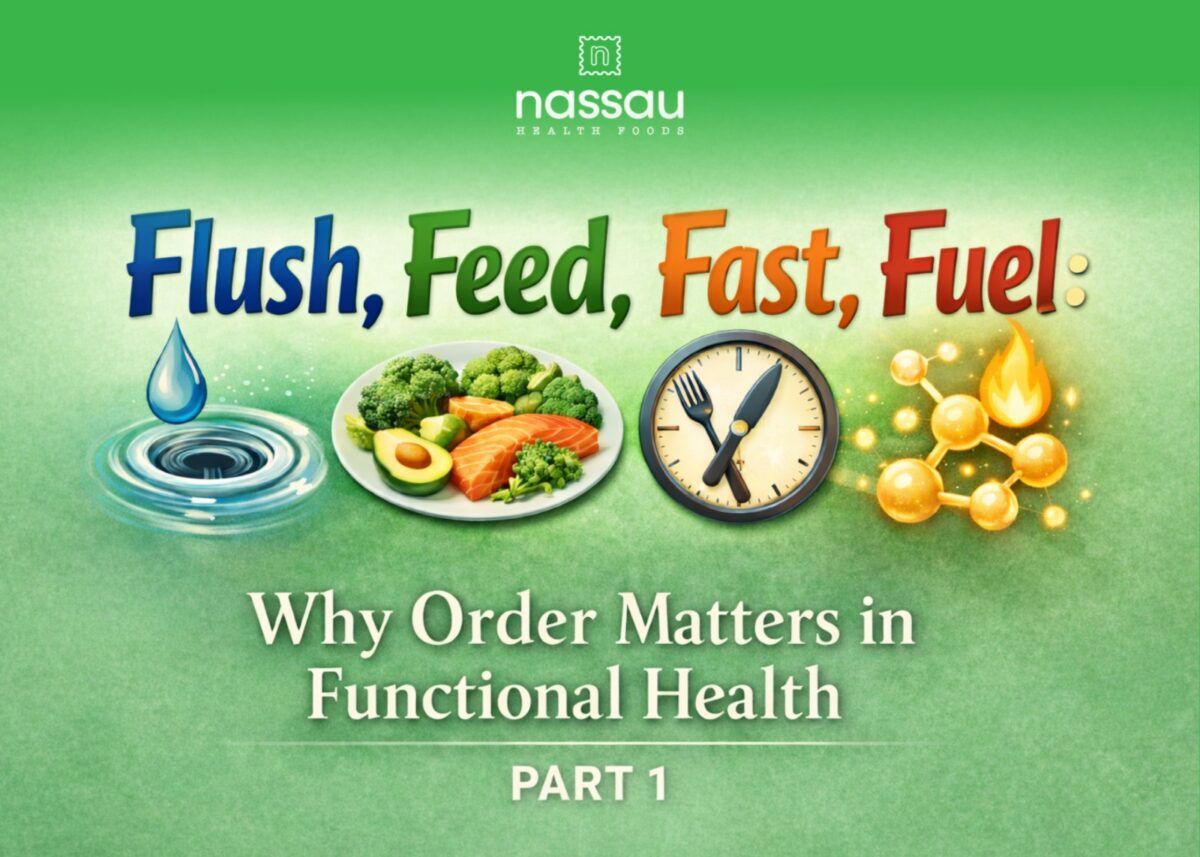
EP 66: Flush, Feed, Fast, Fuel: Why Order Matters in Functional Health (Part 1)
The body is a complex system, and order matters.”

Vince Pitstick

One of the most frustrating experiences in health is doing “all the right things” and still not seeing results.

You clean up your diet.
You try supplements.
You work on stress.
You focus on gut health.

And yet—progress stalls.

In this episode of the Nassau Health Food Store Organic Living Podcast, Steve Adams sits down with functional health expert Vince Pitstick to explore why this happens so often. The issue, they explain, is rarely effort or intention.

More often, it’s order.This conversation introduces Part 1 of the Flush, Feed, Fast, Fuel process, also known as the Four F system—a structured approach to functional health that prioritizes sequence over scattered protocols.


The Body Is a Complex System—Not a Collection of Symptoms

One of the central themes of this episode is that the human body operates as a complex, interconnected system.

When health is approached in isolated pieces—sleep here, gut there, supplements somewhere else—people become overwhelmed. And overwhelmed people tend to quit.

As Steve reflects on his own health journey, he notes how easy it is to forget what it feels like to be a beginner. There are simply too many variables at play:

  • Sleep
  • Stress
  • Nutrition
  • Fasting
  • Movement
  • Emotional health

Without guidance, most people struggle to know where to start—and how to keep going.

Vince emphasizes that coaching is what makes functional medicine truly functional. Having someone walk with you week by week, helping you adjust and adapt, leads to dramatically different outcomes than occasional practitioner visits spaced months apart.


Mental and Emotional Health Often Comes First—Not Last

A powerful insight from this episode is the reminder that many health issues begin mentally and emotionally.

Vince shares from his own experience growing up on a farm and being exposed to environmental and emotional stressors early in life. At the time, his symptoms were labeled as behavioral or psychological, without understanding the deeper physical drivers underneath.

He cautions against assuming that anxiety, intrusive thoughts, or mood challenges are always the root problem.

Often, they are signals.

According to Vince, the nervous system communicates distress through the mind first. When the body has been under chronic stress—chemical, emotional, or metabolic—those signals appear as anxiety, fear patterns, or mood shifts.

This matters because when stress and anxiety become chronic, they activate the sympathetic nervous system. Over time, that constant activation contributes to disease processes throughout the body.


Introducing the Four F Process

The Four F system provides a methodical sequence for addressing health challenges without chasing symptoms.

The four phases are:

  1. Flush
  2. Feed
  3. Fast
  4. Fuel

This episode focuses primarily on why the process begins with Flush and why skipping or rearranging steps often leads to poor results—even when the tools themselves are good.

Vince stresses that the success of this approach is not just about knowledge or protocols, but about organization.


Phase One: Flush — Resetting the System

The first phase, Flush, is about preparing the body to heal.

Rather than starting aggressively with gut protocols or supplements, this phase focuses on:

  • Calming the nervous system
  • Opening lymphatic pathways
  • Supporting liver and gallbladder function
  • Lightly clearing the gastrointestinal tract
  • Stimulating the endocrine system

The goal is to remove friction points so the body can do what it was designed to do.

Vince explains that when these systems are supported early on, a significant portion of anxiety often resolves within weeks. As healing continues, more symptoms fade—leaving behind only what may truly need deeper emotional or genetic work.


Why Starting With the Gut Isn’t Always Step One

Many people begin their health journey by focusing immediately on gut health. Vince acknowledges that this can be effective, but explains why his methodology takes a different approach.

Before going “heavy” on the gut, the Four F process emphasizes:

  • Opening lymphatic flow
  • Calming immune activation
  • Reducing nervous system stress

When gut work does begin in Phase Two, it’s approached with the understanding that the gut is not just about digestion—it’s about the immune system.

Vince notes that approximately 80% of the immune system resides in the gut, which means gut health impacts every system in the body. Shoulder pain, anxiety, infertility, and other seemingly unrelated issues can all be influenced through immune and gut pathways.


Metabolism: The Foundation of Health

A central claim in this episode is that all disease is metabolic.

Vince defines metabolism broadly—not just as calorie burning, but as the body’s ability to:

  • Produce energy
  • Break down substances
  • Process emotions
  • Clear toxins
  • Regulate hormones
  • Manage glucose

When metabolism slows or encounters resistance, things begin to accumulate. Over time, this buildup shows up as elevated blood sugar, inflammation, toxin retention, or hormonal imbalance.The goal of the Four F process is to increase metabolic speed and efficiency, allowing the body to process inputs smoothly rather than storing or reacting to them.


Endocrine Function and Cellular Communication

As part of restoring metabolic flow, the process supports the endocrine system, including:

  • Thyroid
  • Adrenals
  • Ovaries or testes

Vince explains that every cell in the body interacts with thyroid hormone signaling. When these signals improve, cells begin to function more efficiently.

This phase involves:

  • Supporting adrenal and thyroid function
  • Encouraging cellular movement and energy flow
  • Continuing lymphatic and liver support

The intention is not force—but alignment.


From Gut to Blood to Cell

The episode walks listeners through a simple but powerful sequence:

  • Food enters the gut
  • Nutrients move into the bloodstream
  • Nutrients must enter the cell

Once nutrients reach the bloodstream, the focus shifts to:

  • Insulin sensitivity
  • Blood sugar regulation
  • Hormonal signaling (including leptin and ghrelin)
  • Cellular inflammation

This is where fasting strategies begin to play a role—supporting metabolic flexibility, clearing damaged cells, and improving mitochondrial function.


Why Sequence Beats “Perfect Protocols”

To illustrate the importance of order, Vince uses the analogy of a lawn.

You can buy the best seed in the world—but without irrigation, proper timing, and consistent care, the lawn won’t thrive.

The same is true for health.

You can have the right supplements, the right diet, and the right activity—but without proper sequencing, the body never reaches stability.

The Four F process offers a repeatable structure that works even before lab testing is introduced. Vince shares that thousands of people have gone through this process with high success rates using lifestyle changes alone.


A Simpler, More Sustainable Path Forward

This episode does not promote quick fixes or miracle solutions. Instead, it emphasizes:

  • Structure over overwhelm
  • Process over perfection
  • Guidance over guesswork

By approaching the body as an organized system—and respecting the order in which it heals—people experience more consistent, lasting outcomes.


Watch the Full Episode

This blog covers Part 1 of a deeper conversation on Flush, Feed, Fast, Fuel. To hear the full discussion, context, and nuance:

👉 Watch the full episode here: https://youtu.be/YhNcfSHGLLU

🌿 Nassau Health Foods is your local organic and wellness partner.
Shop online anytime: https://nassauhealthfood.com/
Or visit us at 833 T.J. Courson Rd., Fernandina Beach, FL 32034

Transcript Evidence
The following concepts and statements are drawn directly from the episode transcript:
Coaching improves outcomes through consistent guidance (00:03–00:04)
Mental and emotional stress often precedes physical disease (00:05–00:06)
Chronic stress activates the sympathetic nervous system and contributes to disease (00:07)
Phase One focuses on flushing, nervous system calming, lymphatic and endocrine support (00:07–00:08)
Gut health is tied to immune function throughout the body (00:08–00:09)
Health is fundamentally metabolic in nature (00:11)
Endocrine signaling influences every cell (00:12)
Order and organization determine outcomes more than isolated protocols (00:09–00:10)

EP 65: Reduce Toxic Exposure: What Water, Skin, and Everyday Products Are Doing to Your Body, Series 2, Part 2

Before doing anything fancy, you need to reduce exposure.”

Dr. Daniel Kessler

When people think about toxins, they often think about food. But as discussed in this episode, toxic exposure comes from many everyday sources, often in ways people don’t immediately recognize.

The conversation centers on one core idea: before doing anything fancy, the first step is reducing exposure. That means identifying where toxins are coming from and minimizing them where possible. This foundational step matters because the body already has systems designed to filter and eliminate toxins—but those systems can become overwhelmed over time.


Water Quality: A Daily Source of Hidden Exposure

One of the first areas discussed is water quality.

Even when municipal water meets safety standards, it may still contain pharmaceutical remnants and other substances. These remnants can remain present despite treatment processes, and not all water filters remove everything completely.

Listeners are encouraged to become more aware of their own water quality by looking it up by zip code using publicly available resources. The takeaway is not fear—but awareness. Understanding what’s in the water you drink every day is a foundational step in reducing overall exposure.

Key points from the discussion:

  • Municipal water can meet standards yet still contain unwanted substances
  • Pharmaceutical remnants may be present
  • Not all filters remove everything
  • Awareness starts with knowing your local water quality

Small choices, such as choosing higher-quality water options and reducing plastic exposure, are described as practical steps people can take.


Produce: Why Cleaning Matters—Even With Organic Foods

Food quality is another important topic, particularly produce.

While organic options are discussed positively, the episode emphasizes that all produce should be cleaned intentionally. Even organic fruits and vegetables benefit from thorough rinsing.

For non-organic produce, the conversation highlights that some items may be treated with chemicals to enhance color and shelf life. Apples are specifically mentioned as an example where treatments may be used to improve appearance.

The key takeaway is simple: rinsing produce matters. What comes off when fruits and vegetables are washed can be surprising—and reinforces the importance of intentional cleaning practices.


The Skin: The Body’s Largest Organ

A major focus of the episode is skin absorption.

The skin is described as the largest organ in the body, and it absorbs a meaningful percentage of whatever is applied to it. This makes personal care products a significant source of exposure that many people overlook.

Personal Care Products and Hormone Disruption

Certain ingredients commonly found in personal care products are discussed, including:

  • Fragrances
  • Parabens
  • Phthalates

These are described as hormone disruptors, meaning they can interfere with hormonal balance and may mimic estrogen in the body.

The discussion stresses that this isn’t about perfection—it’s about awareness. Many people apply products daily without considering how much the skin absorbs over time.


A Real Patient Story: Reducing Exposure Made a Measurable Difference

One of the most compelling moments in the episode is a real patient story.

A 28-year-old woman, described as healthy and mindful of her diet, showed extremely high autoimmune markers in blood work—levels that should have been zero but were over a thousand.

After reviewing her lifestyle, attention was directed to her personal care products, including:

  • Tanning lotions
  • Makeup applied to the skin and neck
  • Foundation products

The recommendation focused on switching these products.

What Happened Next

After three months:

  • Autoimmune markers dropped from over 1,000 to under 300
  • This change occurred without adding new interventions, simply by reducing exposure

This story illustrates how everyday products can contribute to toxic load—and how reducing exposure can lead to measurable changes.


How the Body Filters Toxins

The episode explains that the body already has natural filters, including:

  • The liver
  • The kidneys
  • The skin

Over time, these filters can become burdened. Many toxins are described as fat-soluble, meaning they can remain stored unless the body is supported in eliminating them.

How Toxins Leave the Body

According to the discussion, toxins can be eliminated through:

  • Urination
  • Bowel movements
  • Sweating
  • Breathing

As toxins are released, people may notice:

  • Stronger body odor
  • Changes in breath
  • Increased sweating

Rather than seeing these as negative signs, they are framed as indicators that the body is actively eliminating stored substances.


Detox Symptoms: Why Discomfort Can Be Normal

A personal experience is shared involving switching to non-toxic deodorant.

During the first 60 days:

  • Body odor increased
  • The body appeared to be adjusting

After this period:

  • Odor normalized
  • Less product was needed overall

This example reinforces the idea that temporary discomfort doesn’t mean something is wrong. In many cases, it can reflect the body adapting as exposure is reduced.


The Rowing Team Analogy: A Practical Way to Think About Detox

Toward the end of the episode, a powerful analogy is introduced by a board-certified toxicologist.

Each rower in a rowing team represents something a person can do to reduce toxic load and support the body’s filtering systems.

The First Rower: Reduce Exposure

Before:

  • Supplements
  • Saunas
  • Exercise routines

The first and most important rower is reducing exposure.

This means:

  • Evaluating water quality
  • Reviewing kitchen and cleaning products
  • Assessing personal care items
  • Asking whether daily choices are helping or harming

Only after reducing incoming exposure does it make sense to focus on supporting detox pathways.


Small Changes, Consistent Progress

The episode emphasizes progress over perfection.

Rather than trying to change everything at once, listeners are encouraged to:

  • Make one small improvement
  • Aim to improve by 1% each day

Over time, these small changes compound, leading to meaningful reductions in toxic load.


A Broader View of Health

The conversation expands on a familiar phrase: “We are what we eat.”
It’s reframed as:

  • We are what we eat
  • We are what we digest
  • We are what we absorb
  • We are what we excrete

This broader view highlights why exposure—from water, air, and skin contact—matters just as much as diet.


Where to Start If You Feel Overwhelmed

A recurring theme is that people often don’t know where to begin.

A simple starting point suggested in the discussion:

  • Ask yourself how you feel
  • Identify one area where exposure could be reduced
  • Make one change

This grounded approach removes overwhelm and keeps the focus on practical, sustainable steps.


Final Thought: Commit to Your Body Daily

Rather than treating health as a short-term resolution, the episode encourages a daily commitment.

Reducing toxic exposure isn’t about extremes—it’s about awareness, intention, and consistency. Over time, these choices support the body’s natural ability to filter and eliminate what it no longer needs.

Read: “Toxin Burden and Your Health: Why What You’re Exposed to Matters More Than You Think, Series 1”

Read: “How Toxins Quietly Shorten Your Health Span, Series 2, Part 1”

👉 Watch the full episode here: https://youtu.be/9UnuCQjnJ5Y
👉 Shop online anytime at https://nassauhealthfood.com/
📍 Or visit us at 833 T.J. Courson Rd., Fernandina Beach, FL 32034

All information, examples, analogies, and conclusions in this article are derived exclusively from the podcast transcript, including discussions on water quality, produce cleaning, skin absorption, hormone disruptors, patient experience, detox symptoms, and the rowing team analogy.
No external studies, statistics, or claims were added.

EP 64: How Toxins Quietly Shorten Your Health Span

Everyone carries some level of toxins—
regardless of age.”

Dr. Daniel Kessler

Most people associate toxins with something obvious—an illness, a reaction, or an emergency. But according to Dr. Daniel Kessler, that assumption is exactly what causes many people to miss the bigger picture.

In this episode of the Organic Living Secrets podcast, Steve Adams sits down with Dr. Kessler to explore how toxins can quietly shorten your health span—the years you live in good health—even when blood work appears normal and symptoms are minimal.

This is not a fear-based discussion. It is a grounded, practical conversation about awareness, everyday exposure, and the small choices that can meaningfully influence long-term health.


What Is Health Span—and Why It’s Different From Life Span

Life span refers to how long you live.
Health span refers to how long you live well.

Dr. Kessler explains that many people feel reassured when routine labs come back normal. But that reassurance can be misleading. A person may technically be “alive and functioning” while slowly accumulating internal stressors that reduce vitality over time.

The problem, he notes, is that people often wait for something bad to happen before they start asking deeper questions:

  • Why didn’t I know sooner?
  • Could this have been prevented?
  • Was there something I could have done differently?

This gap—between feeling okay and actually being healthy—is where health span quietly erodes.


Dr. Kessler’s Background in Environmental Health

Before becoming a practicing physician, Dr. Kessler worked at the Centers for Disease Control, specifically at the National Center for Environmental Health.

His role involved analyzing blood and serum samples from people across:

  • All age groups, from infants to the elderly
  • Populations across the United States
  • Samples from around the world

What he found was consistent and striking:

Every individual—regardless of age—had some level of toxins present in their body.

This exposure was not limited to people who were sick. It was universal.


Why Toxins Are Often a “Hidden Load”

Dr. Kessler refers to toxin accumulation as a hidden load—something the body adapts to over time without producing immediate symptoms.

The human body is resilient. It can compensate for stressors for years. But that adaptation comes at a cost.

Many patients, he explains, experience symptoms such as:

  • Not feeling well
  • Low energy
  • Ongoing discomfort without clear diagnosis

Yet standard blood work often appears mostly normal.

That disconnect is what leads to frustration—for both patients and doctors.


Acute Care vs. Chronic Exposure

Modern healthcare excels at acute intervention.

If someone has:

  • A heart attack
  • A severe infection
  • A sudden medical emergency

The system responds quickly and effectively.

However, Dr. Kessler points out that chronic, low-level exposure to toxins does not trigger alarms. These exposures:

  • Do not cause immediate harm
  • Build slowly over years or decades
  • Often go unaddressed

This is why many people feel something is “off” without being able to pinpoint why.


Types of Toxins Discussed in the Episode

Dr. Kessler explains that the word toxin can be misleading and overly broad. He breaks it down into categories discussed in the conversation:

1. Infectious Toxins

These are produced during infections such as:

  • Flu
  • Viral illnesses
  • Food poisoning

They often cause noticeable symptoms and resolve once the infection clears.

2. Man-Made and Environmental Exposures

These include synthetic chemicals that:

  • Did not exist a century ago
  • Are encountered daily
  • Accumulate slowly

Dr. Kessler notes that the body may encounter thousands of these chemicals over time.

Most exposures do not cause immediate illness—but chronic exposure can quietly contribute to:

  • Inflammation
  • Hormone disruption
  • Reduced health span

Why Feeling “Fine” Can Be Misleading

One of the most important ideas in the episode is this:

Feeling okay does not always mean you are as healthy as you think.

Dr. Kessler emphasizes that many people delay action because nothing feels urgent. They wait for pain, diagnosis, or crisis before making changes.

By the time something shows up clearly, the underlying issues may have been developing for years.


The Kitchen as a Major Exposure Zone

When discussing practical changes, Dr. Kessler starts where people spend a large portion of their time: the kitchen.

Food as a Major Influence

Food matters—not just nutritionally, but chemically.

Dr. Kessler describes food as one of the most impactful daily exposures and notes that sugar is widely recognized as a major contributor to health issues.

He also references recent changes to the food pyramid, emphasizing shifts toward:

  • Less grains
  • More healthy fats
  • More healthy proteins

(Specific details beyond this were not expanded further in the transcript.)


Cookware and Chemical Exposure

Cookware is another overlooked source of exposure.

Dr. Kessler discusses concerns around:

  • Non-stick cookware
  • Overheating or scratching surfaces
  • Release of certain chemicals when damaged

He mentions PFAS—often referred to as “forever chemicals”—and explains that these substances can accumulate in the body over time.

Practical Alternatives Mentioned

  • Switching to stainless steel cookware
  • Being mindful of utensil materials

Plastics and Heat: A Risk Combination

Plastic exposure is discussed in the context of heat.

Dr. Kessler highlights a key principle:

Heat accelerates chemical migration from plastic into food.

He strongly advises against:

  • Microwaving food in plastic containers
  • Trusting “microwave-safe” labels

Preferred Options Mentioned

  • Glass containers
  • Ceramic containers

When storing leftovers, transferring food into these materials can reduce exposure.


Why This Is Not a Fear-Based Conversation

Throughout the episode, Dr. Kessler repeatedly emphasizes control—not fear.

The goal is not to eliminate all exposure (which is unrealistic), but to:

  • Reduce unnecessary exposure
  • Make better daily choices
  • Focus on small, consistent improvements

He stresses that people are far more empowered than they realize.


Small Changes Add Up Over Time

The central message of the episode is simple:

Small, practical changes—applied consistently—can meaningfully reduce toxic load over time.

These changes do not require extreme measures, perfection, or panic. They require awareness and intention.n’t toxin-free and explains that Nassau Health Foods exists to help people make those choices more easily.


Protecting Your Health Span

Health span is not something that suddenly disappears. It is gradually shaped by daily decisions, environmental exposures, and long-term habits.

This conversation invites listeners to stop waiting for symptoms and start thinking earlier—before problems become obvious.

Read Series 1 herehttps://nassauhealthfood.com/ep63-toxin-burden-and-your-health-why-what-youre-exposed-to-matters-more-than-you-think/ 

Read Series 2, Part 2 here: https://nassauhealthfood.com/ep65-reduce-toxic-exposure-what-water-skin-and-everyday-products-are-doing-to-your-body-series2-part2/

👉 Watch the full episode here: https://youtu.be/xUbDOeMWcS8
👉 Shop online anytime at https://nassauhealthfood.com/
📍 Or visit us at 833 T.J. Courson Rd., Fernandina Beach, FL 32034

All claims, examples, explanations, and recommendations in this article were derived exclusively from the recorded conversation between Steve Adams and Dr. Daniel Kessler on the Organic Living Secrets podcast episode discussing toxins and health span. No external sources, studies, statistics, or interpretations were added beyond what was stated in the transcript.

EP 57: The 3 Overlooked Warning Signs of Heart & Gut Imbalance

You deserve a wellness partner who sees the full picture—not just the symptoms.”

Nassau Health Foods

If you’ve ever sat in a doctor’s office feeling exhausted, inflamed, stressed, or “just not yourself”… only to hear:

“Your labs are normal.”
“You’re fine.”
“Let’s wait and see.”

—then this article is going to feel like a deep breath of relief.

Because the truth is simple:

Normal labs do NOT always mean you’re healthy.

And “no symptoms” does NOT mean “no risk.”

In fact, many of the earliest warning signs of heart issues, inflammation, gut imbalance, and metabolic stress don’t show up on routine bloodwork at all.

This is one of the biggest gaps in modern healthcare—and the exact reason so many people on Amelia Island walk into Nassau Health Foods saying:

“My labs look fine but I don’t feel fine.”

If that’s you, you’re not alone.
You’re not imagining it.
And most importantly—you have options.

Today we’re breaking down:

The 3 clearest signs your doctor might be missing something important—PLUS how to get real answers without waiting for symptoms.

Let’s dive into the new era of prevention.


SIGN #1 — Your Labs Are “Normal”… But You Don’t Feel Normal

Let’s start here, because this is the most common frustration we hear every week.

Someone walks into NHF feeling:

  • fatigue that won’t go away
  • heavy legs or poor circulation
  • brain fog
  • digestive changes
  • weird aches or inflammation
  • low motivation
  • slower recovery

Their labs?
“All normal.”

But they know something is off.

Here’s the truth no one tells you:

Standard labs show you if you’re already sick.
They do NOT reveal the early declines in:

  • microvascular health
  • nitric oxide production
  • endothelial function
  • low-grade inflammation
  • subtle gut imbalance
  • metabolic stress

So your doctor isn’t wrong.
Your labs ARE normal… according to the system.

But your body isn’t.

🧠 Think of it like your car.

If your engine light hasn’t turned on yet, it doesn’t mean the engine is perfect—it just means the damage hasn’t gotten bad enough to trigger a warning.

Your body works the same way.

Early dysfunction shows up long before symptoms.

Here’s the good news:

You don’t have to wait until something gets worse.

At Nassau Health Foods, our screenings and preventative guidance help you identify what your labs can’t see—before your body starts shouting.


SIGN #2 — Your Doctor Isn’t Testing What’s Happening Beneath the Surface

This is where the gap between early wellness and traditional healthcare becomes the most obvious.

Most doctors don’t test for:

  • endothelial health
  • microvascular circulation
  • low-grade inflammation
  • nitric oxide function
  • gut microbiome balance

Why?

Because insurance rarely covers these tests unless symptoms are extreme.

But these are the FIRST places health declines.

Let’s break them down.


1. Endothelial Health — Your Body’s Silent Early Warning System

Your endothelium is the protective inner lining of your blood vessels.

It controls:

  • circulation
  • nutrient delivery
  • inflammation
  • healing
  • blood pressure stability

But here’s the catch:

Endothelial decline happens silently—long before symptoms.

You won’t feel it.
You won’t see it.
And your doctor won’t test it.

This is why so many people develop cardiovascular issues seemingly “out of nowhere.”

But the early signs can be measured.

🩺 This is exactly why Nassau Health Foods offers the

Glycocheck Screening — the only vascular age test available locally.

It shows:

  • microvascular flow
  • endothelial function
  • early inflammatory patterns
  • vascular age vs. biological age

All in 10–15 minutes.
Non-invasive.
No waiting.

This one test has changed hundreds of wellness journeys on the island.


2. Chronic Inflammation — The Quiet Fire Behind Most Symptoms

Chronic inflammation is linked to:

  • fatigue
  • joint pain
  • brain fog
  • weight fluctuations
  • aging skin
  • gut issues
  • blood pressure changes
  • mood shifts

But unless it’s dangerously high, inflammation often doesn’t flag in routine labs.

Doctors rarely test:

  • hsCRP
  • homocysteine
  • oxidative stress markers
  • microvascular inflammation

So inflammation quietly damages the body for months or years before it becomes “serious enough” to treat.

At NHF, we help identify inflammation early—and address it gently.

With:

  • Revasca (our most trusted endothelial + vascular support)
  • Omega-3s
  • Curcumin
  • Vitamin D
  • Anti-inflammatory meal plans
  • Gut-supportive foods
  • Gluten-free + antioxidant-rich meals from Amelia Fresh Café

This is prevention you can feel working.


3. Gut Imbalance — The Root of More Symptoms Than Most People Think

If you’ve noticed:

  • bloating
  • irregular digestion
  • food sensitivities
  • mood swings
  • low energy
  • brain fog
  • immune changes
  • skin flare-ups

…your gut might be sending a message.

But doctors often only test gut health when symptoms are extreme.

The gut is connected to:

  • inflammation
  • hormones
  • immunity
  • mood
  • metabolism
  • brain clarity

At NHF, gut health is one of the FIRST things we evaluate.

Because when your gut is off—everything is off.

We guide you toward:

  • probiotics
  • digestive enzymes
  • gut-healing meals
  • elimination guidance
  • anti-inflammatory nutrition
  • simple supplement stacks
  • gluten-free options from the café

A happier gut = a more vibrant you.


SIGN #3 — You’re Given Vague Advice Instead of a Clear Plan

You’ve probably heard advice like:

  • “Eat healthier.”
  • “Exercise more.”
  • “Reduce stress.”
  • “Come back if it gets worse.”

But what does that actually mean?
What foods?
Which supplements?
What needs to change?
Where do you start?

This is where most people feel stuck.

And this is where Nassau Health Foods steps in.


THE REFRAME: You’re Not Getting Bad Care—You’re Getting Incomplete Care

We love doctors.
We respect doctors.
We partner WITH doctors.

But doctors are trained to detect disease.
Not to optimize wellness.
Not to guide nutrition.
Not to spot early decline.
Not to recommend supplements.
Not to help you build healthy habits.

That’s OUR lane.

Doctors catch disease.

Nassau Health Foods helps you prevent it.

This isn’t competition.
This is collaboration.
A full-circle model of wellness—rooted in preventative care.

And that’s exactly what our community deserves.


THE NHF PREVENTION PATH: How We Fill the Gap

Here’s how locals on Amelia Island are catching issues early, getting clear answers, and feeling more energized than they have in years.


1. Glycocheck Screening

Your vascular early-warning system.

In just 15 minutes, you’ll see:

  • your vascular age
  • endothelial health
  • microcirculation quality
  • early metabolic stress
  • inflammatory patterns

This is modern prevention—finally available locally.


2. Revasca Heart + Vascular Support

For daily endothelial and metabolic support.

This supplement is:

  • doctor-formulated
  • third-party tested
  • designed to strengthen your endothelial layer
  • made to pair with your Glycocheck results

It’s one of our most trusted tools for heart and microvascular support.


3. Thrive Wellness Membership

Your personalized path to preventative wellness.

With Thrive, you get:

  • monthly insights
  • nutrition guidance
  • screenings
  • supplement discounts
  • café discounts
  • ongoing support
  • a wellness guide who actually knows your name

This is healthcare without the hassle.
Clear, simple, sustainable.


4. Amelia Fresh Café

Food that loves you back.

Because prevention lives on your plate.

Our menu is:

  • gluten-free
  • vegan-friendly
  • anti-inflammatory
  • gut-happy
  • flavor-forward

Grab-and-go or dine-in—your body will thank you either way.


A LOCAL STORY: When Prevention Finally Clicks

Every week, we meet someone like Susan.

She’s active. She walks the beach every morning.
But recently, she felt:

  • more tired
  • less steady
  • more inflamed
  • less like herself

Her doctor ran labs.
Everything “normal.”

But Susan knew better.

She booked a Glycocheck Screening.
Fifteen minutes later, she saw what the labs couldn’t show:

Early endothelial decline.

Not dramatic.
Not dangerous.
But not something to ignore.

She joined Thrive.
She began Revasca.
She started grabbing gluten-free bowls from Amelia Fresh Café.

Three months later?

Her energy is back.
Her legs feel light.
Her digestion is smooth.
Her screenings improved.

And she said something we hear all the time:

“Finally, someone is watching my health with me.”

That’s what prevention feels like.


THE BOTTOM LINE: You Deserve the Full Picture.

THE BOTTOM LINE: You Deserve the Full Picture.

You deserve answers before symptoms.
You deserve clarity before crisis.
You deserve prevention that fits your life, your body, and your goals.

And you deserve a wellness partner who knows your name, listens to your story, and helps you feel vibrant year-round.

Here on Amelia Island—you have one.


🌿 READY TO SEE THE FULL PICTURE OF YOUR HEALTH?

YOUR NEXT STEP IS SIMPLE.**

👉 Book your Glycocheck Screening today

See how well your heart and microvascular system are aging.

👉 Explore Revasca

Daily vascular + metabolic support you can trust.

👉 Join the Thrive Wellness Membership

Your personalized, guided path to proactive health.

👉 Fuel your day at Amelia Fresh Café

Gluten-free, gut-happy, flavor-forward meals—ready when you are.


Nassau Health Foods
Locally trusted since 1985.
Where prevention becomes simple.

Shop all things organic herehttps://nassauhealthfood.com/ 

EP 34: The Summer of Prevention: How to Feel Better Before You Feel Worse

“You don’t have to wait for something to go wrong… to start doing what’s right.”

The Summer of Prevention, Nassau Health Foods

Have You Checked In on Your Health This Summer?

June isn’t just for travel plans and sunscreen. It’s also a natural checkpoint—a quiet invitation to pause and ask:

🌀 Am I as energized as I want to be?
🌀 Is my body quietly asking for support?
🌀 What if I could prevent disease instead of react to it?

At Nassau Health Foods, we believe summer is the perfect time to shift gears—away from managing symptoms and toward building resilience.

This blog is your guide to making vibrant health the goal, not just “feeling fine.” And it all starts at the cellular level.


The Problem with Waiting for Symptoms

Let’s debunk a common health myth:

“If I feel okay, everything must be fine.”

Here’s the truth: by the time symptoms show up, dysfunction has often been brewing for years.

Fatigue, high cholesterol, brain fog, joint pain, and even erectile dysfunction aren’t isolated issues—they’re often signs of something deeper: metabolic dysfunction, or what Dr. Casey Means calls “Bad Energy.”

So what’s really going on?


Meet the Root of Modern Disease: Bad Energy

Your body runs on energy created by tiny engines in your cells called mitochondria. These powerhouses turn food into fuel so your brain thinks clearly, your heart beats smoothly, and your hormones stay in harmony.

But in today’s world—where sugar is everywhere, stress is constant, and movement is optional—those engines get overwhelmed. The result?

🔥 Inflammation
🚧 Blocked blood vessels
⚠️ Insulin resistance
💤 Low energy
❤️ Higher risk of disease

All these issues point to the same root problem: your cells aren’t making energy the way they should.

And when energy production breaks down, everything else does too—your mood, metabolism, hormones, and heart.


What If You Could See It Before It Becomes a Problem?

Enter the Glycocheck Screening—one of the most powerful tools in prevention today.

What is it?
A non-invasive test that shows how well your microvascular system (the tiniest blood vessels in your body) is working.

Why does it matter?
Because those vessels deliver oxygen, nutrients, and hormones to every organ. If they’re damaged or inflamed, your cells can’t function—and chronic disease creeps in.


What Glycocheck Can Reveal (That Standard Labs Can’t)

Your traditional bloodwork might say “normal”…
But Glycocheck can show:

  • Early endothelial damage (lining of blood vessels)
  • Signs of oxidative stress
  • Microcirculation slowdowns
  • The hidden aging of your heart and brain

Think of it like checking your tire pressure before a blowout.

No symptoms yet? Perfect. That’s exactly when this tool works best.


What to Do If Your Glycocheck Score Needs Help

Prevention doesn’t end with information—it begins with action. That’s why Nassau Health Foods pairs every screening with real next steps.

🌿 Step 1: Rebuild Your Vascular Health with Revasca

Revasca is our doctor-formulated heart health supplement, designed to restore and protect the fragile lining of your blood vessels—also known as the endothelium.

Unlike standard heart pills that just address numbers (like cholesterol), Revasca targets the root: your body’s nutrient exchange highway.

🟢 Improves nitric oxide function
🟢 Reduces endothelial inflammation
🟢 Supports better blood flow
🟢 Third-party tested for purity and potency

It’s the supplement we recommend after Glycocheck—and many of our Thrive Members take it proactively, even with strong scores.


📋 Step 2: Join the Thrive Wellness Membership

Health isn’t a one-time event—it’s a relationship. The Thrive Membership Plan is our way of helping you:

✅ Track key markers regularly
✅ Save on supplements, labs, and café meals
✅ Stay out of the sick-care system

Whether you’re trying to prevent heart disease, reduce inflammation, or just feel amazing every day, Thrive gives you structure and support without overwhelm.

No confusion. No 12-pill stacks. Just real progress.


🥗 Step 3: Eat (and Live) Like Energy Matters

Prevention isn’t only in a capsule or a test—it’s in your everyday choices.

Here’s what we see work again and again with our customers at Nassau Health Foods:

TipWhy It Works
🥬 Eat more colorful, fiber-rich foodsFeeds your microbiome and cools inflammation
🚶‍♀️ Take 15-minute walks after mealsImproves insulin sensitivity and digestion
😴 Prioritize sleep like medicineCellular repair depends on deep rest
💧 Filter your water and avoid plasticReduces chemical load on your mitochondria
🧘‍♂️ Practice breathwork or morning sun exposureBalances stress hormones and sets your circadian rhythm

You don’t have to overhaul your life. But small consistent shifts—paired with smart testing—create massive results.


Real Prevention, Right Here in Amelia Island

Here’s the best part: you don’t have to fly to a fancy clinic or wait until you’re in crisis.
You can start right here, this week, at Nassau Health Foods.

Whether you’re 38 and tired of feeling foggy, or 63 and determined to skip your parents’ health path—this is your moment to pivot.

No judgment. No pressure. Just real tools to help your cells work with you, not against you.


This Summer, Flip the Script

Too many people think “I’m not sick, so I don’t need a plan.”
But health isn’t a light switch—it’s a spectrum. And you get to choose where you land.

Imagine walking into your next birthday feeling:

🌞 Energized in the morning
❤️ Confident in your heart health
🍽️ Nourished by real food
🧠 Clear in your mind
🛡️ Empowered—not reactive

That’s what this summer can kickstart. A Summer of Prevention.


Key Takeaways

  • Don’t wait for symptoms. Start with simple, clear insights like Glycocheck.
  • Support your blood vessels. Revasca targets the heart of prevention.
  • Stay on track. Thrive gives you structure and savings to keep going.

Fuel your mitochondria. What you eat, breathe, and believe matters.


Your Next Step Starts Here

📍 Visit Us In-Store:
Nassau Health Foods
833 T.J. Courson Rd, Fernandina Beach, FL
📞 Call: (904) 277-3158

🛒 Or Shop Online:
👉 https://nassauhealthfood.com/


Your body wants to thrive. And with the right tools and community, it absolutely can.
Let this be the summer you shift from “just getting by” to “this is what vibrant feels like.”

We’ll be here cheering you on—every meal, every test, every mindful moment .You don’t have to wait for something to go wrong to start doing what’s right.


Let’s make this a Summer of Prevention—together.

Your map to healthy eating.

Conveniently located near the beach and downtown.

Mon-Fri: 8am – 7pm

Sat: 8am – 6pm

Sun: 10am – 4pm

Tel: (904) 277-3141

Tel: (904) 277-3141

Mon-Fri: 8am – 3pm

Closed on Saturday & Sunday

Order Online

Get Directions